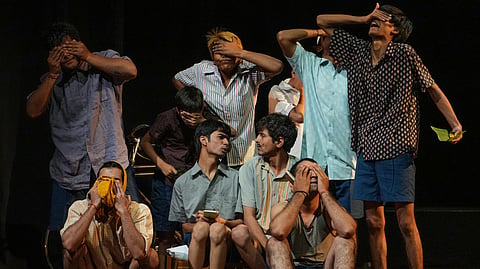

What does childhood look like when seen through the eyes of a 12-year-old? There are friendships that seem unbreakable, games made out of whatever is available, mischief in the neighbourhood and conversations about a world that children are only beginning to understand. These memories now live on in Lapoojhanna, a stage adaptation of a novel by well-known Hindi author Ashok Pande, directed by Anuranjan Sharma. It was performed over the weekend at Delhi’s Triveni Kala Sangam, followed by a show at India Habitat Centre.
‘Lapoojhanna’ is a colloquial word used teasingly or dismissively in Uttarakhand and north India, to describe something insignificant or of little consequence. Yet the production finds meaning in precisely those seemingly insignificant moments — that of a childhood game, a conversation between friends, a teacher’s scolding, or the memory of a familiar neighbourhood.
Set in Ramnagar, Uttarakhand of the mid-1970s, the play takes audiences back to a time before mobile phones and the internet, when children spent hours playing outdoors and built their own worlds away from the concerns of adults. Through humour, satire and moments of sadness, it explores friendship, school life, first love and the experience of growing up in a small town.
Published in 2022, Lapoojhanna brings together Pande’s memories of growing up in Ramnagar, where he lived for a few years before moving to Nainital for his schooling. The novel, in fact, took shape after Pande began sharing stories from the town on Facebook, where readers encouraged him to write more. Over time, these grew into 50 to 60 anecdotes that captured the people, language and daily life of the town.

Fit for stage
For Sharma the novel’s dramatic characters and situations made it a natural choice for the stage. “When I read that novel, I felt that it was very theatrical. It has a lot of drama, emotions… and a language of its own,” he says.
The adaptation follows young Ashok and his friendship with Lafattu, a fearless and mischievous boy. “The binding element [of this story] would be friendship… this really pure friendship that you have at this [young] age,” says Pande.
What will also connect with an urban audience is that the play also touches on religious divides and prejudices – though through the eyes of 12-year-old Ashok. It features a “Pakistan” in Ramnagar, referring to an area populated by the region’s Muslim community. However, it also shows how children rise above these biases as they befriend one another, eat together and exchange gifts. The author says he did not set out to convey any particular message through the story. Instead, it is an attempt to collect and preserve memories that he felt were worth holding on to.
He also describes seeing the adaptation as an unusual and moving experience. Watching young actors portray people from his memories made him reflect on how a personal story changes as it passes from one person to another.
Crisp dialogues, local language
The play opens with a song that goes, “Bachpan ki khidki, khul jayegi ab; dekhega phir tu woh aasmaan ab (The window to childhood will open again; you will see that sky once more)”; it keeps the audience hooked till the end with bursts of laughter, timeless Bollywood tracks and many emotional moments of separation and grief.
Language is another important part of the production. Pande wanted to preserve the local expressions and vocabulary he remembered from Ramnagar, some of which he says are rarely heard elsewhere. Hence to bring that essence, the dialogues have been kept crisp, and the language colloquial, both in the novel and the play.
To bring the story to the stage, Sharma worked with Gaurav Kumar and Vijay, both part of the acting team, on adapting the novel. The process took nine months, followed by three months of rehearsals with a team of 25. The production also features original songs, composed by the group comprising Himanshu Vyas, Raghav Maru, Shubham Soyal, and Ritesh Saini.
The team even travelled to Ramnagar to research the setting and meet people connected to the stories. According to Sharma, many of the places described in the novel remain much the same. The town’s slower pace of life also offered the team a way to understand the little details of life in Ramnagar. Sharma points out that while the town has seen some development, its slower pace of modernisation has helped preserve a sense of community.
The changing rhythms of life
The play also raises questions about how childhood has changed over the decades. Sharma sees a change in the way children engage with their surroundings today. The play also raises questions about how childhood has changed over the decades. Sharma sees a change in the way children engage with their surroundings today. “There is an excessive tilt towards building up the mind—everything happens inside the head, but a child's connection with the physical body has diminished,” he says, reflecting on how an excessive focus on building children's cognitive skills has made them less inclined to participate in outdoor, group activities that build a sense of community.
He adds, this shift is not limited to children. It shows a wider change in how people spend time together. “There was an era of going together, buying tickets, and experiencing a film collectively on 35mm. Today, especially with OTT platforms, that shared unity is gone—individuality has taken over, and we spend far less time together, living somewhat isolated lives.”