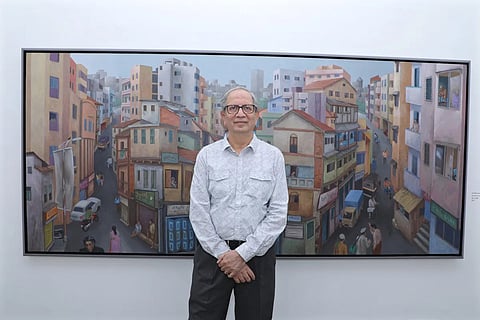

Drawings and sketches often offer a glimpse into an artist’s thought process. For artist Sudhir Patwardhan, they are also a way of understanding the world around him and responding to what he sees.
His recent exhibition at Delhi’s Vadehra Art Gallery, ‘In Another Mode: Sudhir Patwardhan’s Drawings 1970–2000’, brought together sketches and drawings from the first three decades of his career. Curated by art historian Siva Kumar, the exhibition looked at a part of Patwardhan’s practice that often remains behind the scenes, offering viewers a closer look at his creative process and the ideas that have shaped his work over the years.
Looking at works made several decades ago has also given the artist a different perspective on his own practice. While he can understand how they contributed to his development, he says he no longer identifies with them in the same way.
“I do look at them differently. In the sense that they seem as if someone else has done them. I can intellectually understand their role in my evolution, but do not see myself in them today,” Patwardhan adds.
Patwardhan is known for his paintings of people and the city, particularly Mumbai, near Thane, where he lives. His works often focus on ordinary people and their everyday surroundings. In his curatorial note, Kumar described him as a “preeminent painter of people and the city”.

For Patwardhan, this focus on people and their surroundings comes naturally. “It is natural for me to focus on people and situations around me, that I am a part of, rather than go in search of exotic or other 'subject matter'. Capturing the world just happens as a byproduct of this praxis,” he explains.
“All art is an attempt to understand the world, including yourself, people around you and the world.”
Sketches and studies
The exhibition featured two broad types of drawings. The first included smaller sketches. Referring to these sketches, Kumar wrote, “... They (These smaller drawings) are often sketchy and mostly notations made from life. They take us behind the canvas, into the studio and his mind, as it were.”
The second group consisted of larger drawings, some of which were made in preparation for paintings, while others stand independently. One such larger work is ‘Riot’, which resembles a rough sketch marked with traces of paint—as if the artist were testing a foundational concept for a larger piece; this work serves as a preparatory study for a subsequent, finished painting titled ‘The Riot’.
Raw, creative instincts
Patwardhan has long considered sketchbook work an important part of his practice. He believes that drawing helps an artist begin thinking through an idea, whether by making an initial note, exploring a form repeatedly or trying to capture a particular gesture.
His note at the exhibition read: “Sketches not only show the range of an artist’s concerns, they unveil the complex two-way passage between ‘eye, mind and hand’.”
For Patwardhan, drawing is the first response to what one sees. “The materials used are simple and the process mostly spontaneous. Paintings usually grow out of the observations one records in drawings but then go through many stages of development. They are a considered statement,” he tells TMS.
Many of his works feature people with serious or sombre expressions. When asked about the thought behind this choice, Patwardhan explained that it simply reflects how he views the world around him. There is no deliberate motive, "except that that is what I see and respond to, he notes.
One of the works discussed by the artist is ‘F Léger in Pokharan’, which shows his interest in the style of French modernist Fernand Léger with his own observations of Pokharan in Thane. Rendered primarily in black acrylic, the artwork features subtle traces of green, brown, blue, and yellow—likely inspired by Léger's signature palette. Léger himself is depicted holding a bicycle and looking back toward the viewer.
Speaking of the artwork, Patwardhan says, “Leger is an artist I always liked and identified with because he believed in people’s art.” Hence, the choice randomly occurred to him to include the artist in his work.
In another sketch titled ‘Sleeping Beggar’, the artist depicts a bony, skeleton-like figure lying on the ground as if asleep. His ‘Worker Series’ also offers a poignant glimpse into the working class, portraying labourers with a sombre, contemplative look.
Finding a voice
Reflecting on the challenges facing young artists today, Patwardhan notes that the growth of communication, mass media and the availability of different media in the digital age has made it challenging for artists to find their own voice. “Staying close to one's own experience is the key to finding one's own voice,” he advises.
(‘In Another Mode: Sudhir Patwardhan’s Drawings 1970–2000’ was on view till October 23, at Delhi’s Vadehra Art Gallery)