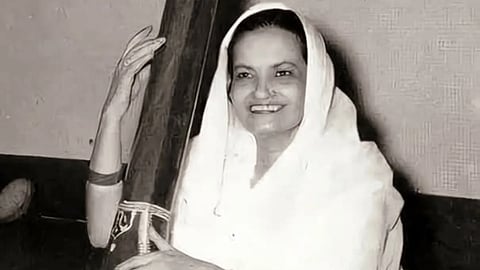

Long before internet sensations and influencers, there was Akhtari Bai Faizabadi, the original diva. She smoked from a long black cigarette holder, wore velvet gowns on stage, starred in films and topped the record charts. Then she walked away from it all and came back bigger than ever. More than a century after her birth, Begum Akhtar is still the Malika-e-Ghazal, the queen of the ghazal — her ghazals and gayaki still evoke admiration and love. In an age of swipes and situationships, she reminds us that love was once whispered in couplets, with subtlety and style.
I learnt music in her lineage, so I grew up on stories about her — incredible music, some legend, and some bits of gossip, all irresistible. While working on creating Akhtari in 2013, my tribute performance, I realised her life and music were inextricably fused together. The patti lagana — the inflexion in her voice seemed metaphorical of the heartbreak that was lived first.
She was born in 1914 in Faizabad, the old capital of Awadh, called Ayodhya today, the same town that gave us Umrao Jaan, the legendary courtesan of Mirza Hadi Ruswa's novel, a story that has become familiar to us through the beautiful movie by the same name. Akhtari's mother, Mushtari Bai, was a tawaif who raised her alone. Her father, from the local gentry, was never part of her life, and her twin sister Zohra died in childhood. Loss came early and never quite left her voice. Love as pain became her signature, generations before sad playlists made melancholy fashionable, though her friends teased that she grew so used to sadness she could ‘manufacture’ it on a perfectly good day.
From a very young age, Akhtari became a popular performer. In 1920s Calcutta, she acted on stage, sang at private mehfils, and moved to Bombay in the 1930s, where she was drawn to the world of films. She did act in some, but quit cinema in 1939. Years later, she made a cameo as a singer in Satyajit Ray's Jalsaghar (1958), where she is seen sitting with her tanpura, singing a gorgeous Thumri Bhar Bhar Aayi Mori Akhiyan.
Her mother feared the film world would swallow her music, that it could mean the end of her singing career. Worried, she took Akhtari to a Pir Saheb. He asked for her bayaz, — the precious notebook of songs every singer guards with her life — opened it at random and told her to record that very ghazal. Thus, was recorded one of her big hits — Deewana banana hai to deewana bana de.

Back in Lucknow she ran her own salon, managed by her mother, where only the most distinguished were let in. Her 78 rpm records on the Megaphone label had made her famous across North India. Trained originally in khayal gayaki by gharanedar Ustads, she chose the so-called ‘lighter’ forms of thumri, dadra and, above all, the ghazal, which she sang with a classical depth no one has matched. She brought to Ghazal Raagdari, redefining the musical interpretation of the form.
With her immense popularity, poets of the day wrote for her, and they knew that if she sang their ghazal or Nazm that could mean popularity or fame. Many of them like Jigar Moradabadi, Shakeel Badayuni and Kaifi Azmi were good friends. My Guru, Shanti Ji, once told me that Shakeel once slipped her a scrap of paper as she boarded a train from Lucknow to Bhopal. By the time she arrived, she had composed what he had given her and thus was born perhaps one of her most iconic and loved ghazals — Ae mohabbat tere anjaam pe rona aaya.
Then came a major shift in her life. She found love. She had always longed for a ‘normal family life’ and went on to marry Ishtiaq Ahmad Abbasi, a Lucknow barrister. She was loved and accepted as “Acchi Ammi” in his family. But in the 1950s, a professional singer in an elite household was unthinkable. She stopped performing. The silence broke her, and depression followed. Finally, after trying all kinds of medical help, she found her remedy in what was closest to her heart — music.
With her husband's support, she returned through a recording at All India Radio, Lucknow, where she sang the poignant dadra, Koyaliya mat kar pukar. The announcer was unsure how to address the artist, given that in her earlier avatar she had been referred to as a ‘Bai’, but was now a married lady. The recording engineer announced her to listeners as Begum Akhtar. The name stuck forever. And thus began another chapter – one filled with renewed happiness. She was known to be witty, mischievous and surrounded by friends, fans and admirers. A popular story goes that the Nawab of Rampur, smitten, gave her a silver chair. Complaining about him once, she was told by her friend Syeda Raza to just leave the man. "I will," she replied, "as soon as I get a table to match the chair."
She broke rules that mattered, bringing to the world of traditional music some feisty feminism! My Guru said she is said to be the first woman Ustani to tie the ganda, the sacred thread of the guru-shishya bond, on her women students, a ritual that had belonged only to men.
In a time when so much feels divided and shared histories are quietly fading, Akhtari’s rendition of Jigar's ghazal stands as a powerful testament to strength and resilience.
Hum ko mita sake, ye zamane mein dam nahin,
humse zamana khud hai zamane se hum nahi
Bai, Begum, Ammi. She was a trendsetter and an epoch maker, who set her own boundaries long before anyone called them that, and whose voice still finds new listeners. Press 'play' on any of her ghazals and you will hear why.
Vidya Shah is a musician and director of 'Women on Record (Stories and Songs from the Gramophone Era)' and 'Akhtari- a Tribute to Begum Akhtar'.