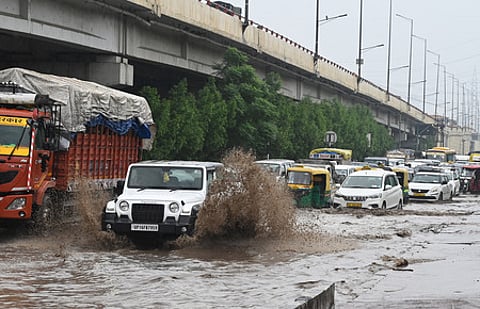

The arrival of the monsoon is an occasion for celebration. The months of Shravan and Bhadrapad occupy a special place in our cultural imagination. From Kalidasa to modern poets, the Indian monsoon has always inspired some of the most evocative poetry, music and literature.Today, in Delhi-NCR, the monsoon increasingly inspires anxiety.
The problem is not the rain. The problem is the city we have built rather the city we have failed to build around the rain.The irony could hardly be sharper.
As the government celebrates the newly notified Master Plan for Delhi 2047 (MPD-2047) and speaks of a future Delhi capable of accommodating dramatically greater density, including buildings of more than 100 floors, the neighbouring city of Gurugram is once again demonstrating what happens when vertical growth races ahead of civic infrastructure.
The capital has little choice but to explore more compact and transit-oriented forms of development if it is to accommodate a growing population without endlessly spreading into its remaining open spaces.But there is a fundamental question that must be answered whether the city beneath the skyscrapers cope with vertical growth.
Gurugram’s misery provides the lesson Delhi must absorb before it embraces the skyscraper as a symbol of modernity.
A skyscraper is not an independent object. It is an enormous concentration of people, vehicles, sewage, waste, electricity consumption and water demand on a relatively small piece of land. Every additional floor may be an engineering achievement, but every additional resident also places a demand on the public infrastructure beyond the building’s gates.
Delhi must therefore resist the temptation to confuse vertical construction with urban development.The two are not synonymous. Infrastructure must come before density, not after it. Before an area is permitted to accommodate thousands or tens of thousands of additional residents, authorities must establish whether it has adequate water supply, sewerage, drainage, roads, public transport, electricity, schools, healthcare, emergency access, parking and open spaces.
The numbers themselves should induce caution. MPD-2047 projects Delhi’s potable-water requirement at around 1,600 million gallons a day by 2047, compared with present availability of about 1,000 MGD.
Even after proposed augmentation, a substantial gap could remain, while some of the additional water sources identified in the plan are themselves described as tentative.
On drainage, too, questions remain about the precise implementation framework. If these questions are not resolved before densification, Delhi could repeat the very mistake that Gurugram has already made. We must also remember that the national Capital region not merely a collection of plots available for maximum exploitation. It is an ecological system.
It has diverse topography, it has rivers emanating in the Himalayas and in the Aravalis. These river systems have floodplains, lakes, parks, forests and an intricate natural drainage geography. Every acre of land covered in concrete changes the way rainwater moves through the city. This is what was not taken into account during the concretisation of Gurugram.
The monsoon is therefore not an inconvenience that urban planning must somehow defeat. A modern city should welcome rains.
Imagine a Delhi in which the monsoon means cooler evenings, fuller lakes, green parks, and revived water bodies, not stranded commuters, flooded underpasses, submerged cars and hours spent crawling through the traffic.
That is a far more meaningful definition of a world-class city than the number of floors in its tallest building. The challenge before the Delhi’s planners is consequently not whether Delhi can build 100-storey towers. Engineers can solve that problem.
The real challenge is whether Delhi can build the 100-storey city around those towers, the invisible infrastructure of drains, sewers, water mains, roads, public transport, emergency services, schools, parks and public spaces that make dense urban living possible.
And this is where accountability becomes indispensable. Let us build upwards, as that is what the city’s future requires. But let us first build downwards and sideways, the drains, sewers, water networks, roads, public transport and open spaces. Let us make the city capable of absorbing the rain before we make it capable of absorbing millions more people.
Sidharth Mishra,
Author and president, Centre for Reforms,
Development & Justice
