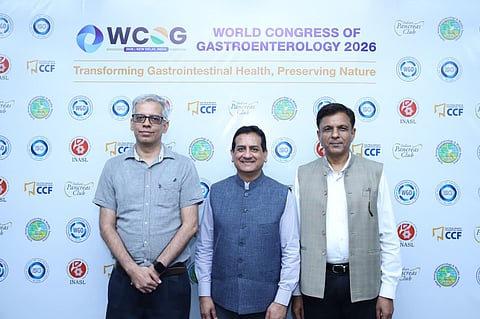

NEW DELHI: The national capital is set to host the first World Congress of Gastroenterology in India, with around 3,000 delegates from 51 countries expected to attend the four-day event from September 30 to October 3.
The World Congress of Gastroenterology (WCOG) 2026 is being organised in partnership with the Indian Society of Gastroenterology and the World Gastroenterology Organisation.
Addressing a press conference at AIIMS Delhi on Tuesday, doctors who are a part of the event’s organising committee said the event will bring together international and Indian experts in gastroenterology, hepatology, endoscopy and related fields.
Around 60 international faculty members and more than 500 national faculty members are expected to participate.
Among the prominent international participants will be Nobel laureate Barry Marshall of Australia, who was recognised for the discovery of Helicobacter pylori and its role in peptic ulcer disease.
Dr Pramod Garg, Professor and Head, Department of Gastroenterology and Human Nutrition, AIIMS New Delhi and President, Indian Society of Gastroenterology, said the programme will feature more than 1,100 original research abstracts, with researchers from India and abroad presenting their work.
Additionally, the conference will focus on gastrointestinal diseases that affect large populations but often receive less attention, including H. pylori infection, fatty liver disease and gastrointestinal cancers.
Experts further stated that gastrointestinal symptoms were extremely common, with around one in three people experiencing symptoms such as constipation, diarrhoea or other digestive complaints. However, they cautioned that certain symptoms should not be dismissed as routine.
Bleeding in the stool and difficulty swallowing or dysphagia should prompt medical evaluation, the doctors also mentioned. They particularly stressed the need for people in their 50s and 60s with new or persistent digestive symptoms to seek medical attention rather than self-treating.
Further, the doctors discussed colorectal cancer and the importance of detecting and removing certain polyps before they turn cancerous. Studies are currently underway in India to assess the prevalence of such polyps among otherwise healthy people around the age of 50, they mentioned.
While addressing the media, Dr Shalimar, Professor, Department of Gastroenterology and Human Nutrition Unit, AIIMS, said the conference would also provide students and young researchers an opportunity to interact with international experts and learn about emerging research in gastroenterology.
