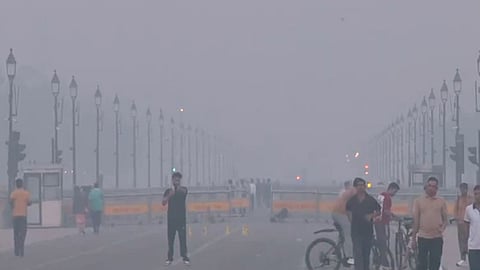

NEW DELHI: As winter approaches and the air pollution season typically begins in October across Delhi-NCR, the Ministry of Environment, Forest and Climate Change (MoEFCC) is working with the five states surrounding the region to work on measures to curb pollution.
States such as Rajasthan, Uttar Pradesh, Haryana, Punjab, and Delhi have developed action plans that include strict regulations on agricultural residue and stubble burning, checks on construction and demolition activities, and measures to control vehicular emissions. All the states emphasised the importance of encouraging behavioural change by utilising social media to influence citizens.
Union Minister for MoEFCC, Bhupendra Yadav, welcomed the detailed action plans prepared by the state governments to ensure citizen participation in combating air pollution. He highlighted specific initiatives undertaken by these states and urged others to adopt and replicate best practices.
Yadav particularly emphasised the need for strengthening information, education, and communication (IEC) activities, as well as behaviour change communication by engaging grassroots communities involving all stakeholders.
During his discussions with the state governments, Yadav stressed that coordinated and focused stakeholder engagement is essential for making air pollution mitigation efforts more effective. He said, “The IEC activities proposed by different states should be undertaken in a coordinated manner to achieve greater outreach and impact.”
Yadav suggested that union ministers for agriculture, environment, and urban development meet with their respective state counterparts to devise coordinated strategies for addressing air pollution. He also emphasised that state pollution control boards must focus on identified air pollution hotspots and develop practical and effective action plans for their mitigation.
In his discussions with state authorities, the minister insisted that "non-compliant polluting industries must be dealt with firmly, following a ‘Zero-Tolerance policy.” He highlighted the need to assign responsibility for violations and defaults, advocating for publicising non-compliant stakeholders as a measure to ensure greater accountability and compliance.
The minister pointed out that IEC activities alone will not be sufficient, and effective implementation and enforcement are critical to tackling air pollution. He announced that a review meeting at the level of the union minister would be held in September to assess the progress of initiatives and actions taken by the concerned states. He reassured the state governments that the centre would provide full support for their efforts in air quality management.
