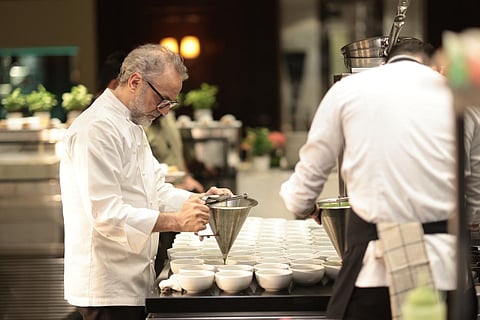

There was a time when a Michelin-starred chef’s arrival in Delhi meant an elusive experience for the privy few, and a press release that rarely ever did justice to chefs. Today, the era feels different—for the stalwarts of food are no longer reserved for few, but are superstars and celebrities of their own right.
Last week, Massimo Bottura and his team recreated Osteria Francescana at Le Cirque, The Leela Palace—his fourth time at this venue since 2023. Fellow chef Takahiko Kondo brought Gucci Osteria as well to Indian Accent. The experience was opened up, albeit with limited seating, to anyone willing to pay for a seat—and the places vanished before anyone could even blink. Delhi, clearly, has decided it wants more of this.
In fact, the room didn’t just show up—it queued, it Instagrammed, it paid without blinking, and it has talked about the evening ever since.

Having seen Delhi and its ancient love affair with food for over a decade, I found this hunger for such experiences to be a new obsession in the city. Beyond those in the industry, for every diner in the room, it is no longer just about the food landing on the plate. It’s about proximity to a name they’ve read about, a craft seen only in documentaries, and to belong to a dining hall that, for one night, will be a true privilege—being small, closed-door and more curated than anything that money can usually otherwise buy in this city.
Delhi has always loved exclusivity; what’s changed is that exclusivity now comes plated in seven courses, too.
Why do I feel that our desire to see a top chef up close has gone mainstream? If you speak with anyone who was a part of one such dinner, you’d see that the conversation would rarely dwell on the food itself. It, interestingly, moves quickly to the theatre of it all—of how Bottura came out table to table, explained each course himself, posed for a photo, shook a hand. That handshake became the story carried into the next dinner party, told and retold long after the six courses by Bottura became snapshots.
That, it seems, is the real currency being traded today: the meal is the ticket, the access is the prize. And, this is only possible when more than just hardcore enthusiasts get obsessed with what was until quite recently a niche craft, at least in India.
Increasingly, it isn’t even individuals footing this bill. Corporates have become the biggest patrons of Delhi’s visiting-chef circuit, booking out entire evenings for clients, sealing deals over nine-course menus
instead of a boardroom table. In some way, one can even say that for some top corporates, tables like Bottura’s is akin to what hospitality boxes in cricket matches were. In a way, it goes beyond.
You see, a high-ticket dinner with a global chef does something a conventional client dinner cannot: it signals taste, reach and affluence, all in one evening—and gives everyone at the table something to talk about that has nothing to do with quarterly targets. For a certain kind of Delhi business relationship, that’s worth far more than the invoice.
I, for one, cherish and love this evolution, too. But, I couldn’t help asking myself if Delhi’s own chefs, the ones quietly refining regional Indian techniques in far less glamorous kitchens, would ever command this same willingness and allure of access—rather than just food. Perhaps that’s the exclusivity Delhi hasn’t learned to want yet.