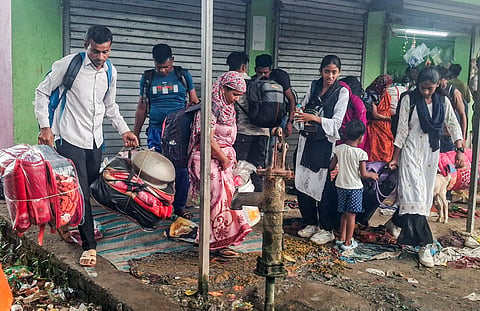

In West Bengal, more than 60 lakh voters were placed under adjudication after the Special Intensive Revision (SIR) of electoral rolls, while more than 63 lakh were deleted from the rolls by the time the post-SIR lists were published in February. With appeals still pending, the regime change in the state has only intensified doubts about identity and the documentation to prove it.
Journalist Nidhi Dugar Kundalia explores the state of unbelonging in The Undocumented, a book that follows people living precariously in a place that does not yet claim them. Set between 2009 and 2011, the narrative predates the current political anxieties over electoral rolls. At its centre is Safrat, a woman from the Bangladesh side of the Sundarbans, and her children, whose story begins long before the current debate over migration and identity.
In May 2009, Cyclone Aila tore through the Sundarbans, leaving behind a people without homes, livelihoods that could not be rebuilt and families forced to reckon with a landscape that had suddenly become unliveable. The disaster eventually became one thread in a much longer story that would take the writer from the Sundarbans to Kolkata's slums.
Kundalia’s work has often centred on communities that remain underrepresented. She had arrived in Kolkata years earlier with little idea that migration would become a subject she would keep returning to for more than a decade. It began, almost accidentally, with a domestic worker.

A chance discovery
The man had dropped something while helping her move house. In his panic, he swore by Allah that he had done nothing wrong, before quickly correcting himself with “Bhagwan kasam.” Kundalia told him it did not matter to her if he was Muslim. The man’s response stayed with her. “It might not matter to you, but it does to others,” he had said.
That moment sent Kundalia into Kolkata’s slums, trying to understand why some workers presented themselves as Hindus. She began following migrants who had crossed over from Bangladesh, speaking to people who had made homes in West Bengal, and asking: why does someone leave home?
Over the years, that question led her to Safrat and her children. Kundalia watched the family move from one slum to another, change jobs and alter the ways in which they presented themselves to the world. Safrat's choices, she says, were often less about politics than survival.
“Safrat didn't choose a false name because of any party or any policy,” Kundalia says. “She chose it because she's a mother.”
It is a distinction that becomes important to the book. The political language around migration tends to arrive with large nouns—infiltration, illegal immigration, citizenship, borders. Kundalia's interest lies in what happens underneath them: the person who has to find work the next morning, pay rent, feed a child and decide what name is safest to use.
An unfolding migration
Documentation is not the only problem of such families. Kundalia describes a three-tiered network operating within the slum economy, with agents demanding protection money from migrants. “The amount kept increasing, while those involved in collecting garbage could even find themselves returning the garbage along with the money they had paid,” she says. Where the protection money ultimately went remains unclear, but the system made migrants dependent on networks that profited from their vulnerability.
It was particularly after the Covid-19 pandemic that Kundalia began to think of people like Safrat as “the nobodies of the society”.
“They do not belong to anybody,” she says. “Nobody has a claim on them. If they disappear from the face of this earth, nobody will get to know about it.”
Before Durga Puja last year, when she visited the slum, residents told her they would have to leave because of the impending Special Intensive Revision of electoral rolls. Garbage collectors, domestic workers and shrimp collectors were deeply embedded in the local economy, she says; their precarious status did not make them oblivious to current affairs.
Kundalia's reporting took her to tea sellers, parking-fee collectors, sweepers and local drivers connected to the slum economy, as well as human rights lawyers, mental health workers and people working in correctional homes. Scholars helped her place contemporary migration against earlier movements following Partition and in the 1960s, 70s and 80s.
The process, she says, was also about figuring out how much of herself should enter the story. “I was trying to tell a story where I was removing myself from the story,” she says, “and let the people who are a part of my story, let them tell their own story.”
Calling out, protecting identities
That restraint becomes particularly significant when the book enters politically sensitive territory. Kundalia says she has tried to name institutions and systems—police indifference, communal prejudice and the economics of local syndicates—while withholding the identities of individuals whose actions could expose them to legal or personal consequences. Legal teams were involved in changing some names, particularly to protect whistleblowers, something she considers part of the ethics of narrative nonfiction.
For Kundalia, however, the book was never intended as a political account of Bengal. “For me, it’s about the people underneath the politics,” she says. “The ones who don't wait for an election.”
Safrat does not have the luxury of waiting for an election result before deciding how to survive the week. The political argument may change; the immediate questions of food, shelter, work and safety remain.
“Whichever side of the debate you're on,” she says, “you see the family first, and an argument second.” And perhaps that is why she wants the story read in full—not to settle the argument over migration, but to make it harder to have one without first seeing the people inside it.