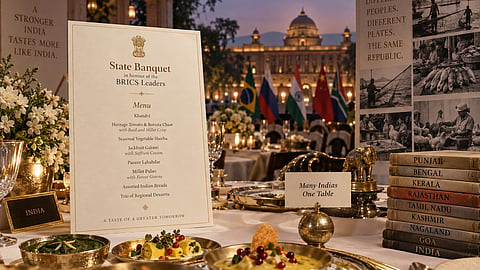

The menu card from the recent BRICS state banquet held in Delhi last weekend has stayed with me. An elaborate spread, by all accounts, and entirely vegetarian. No fish, no poultry, no meat, no eggs. Just one register of Indian food, offered up to the world as the whole song.
Let me say the obvious thing first, because it always needs saying before this conversation can go anywhere useful: no one is objecting to vegetarian food. I am a vegetarian myself. I have also spent a decade photographing, researching and archiving Punjabi food culture, and I believe our vegetarian traditions—Gujarati, Rajasthani, Tamil, Maharashtrian, Telugu, Punjabi—are among the most inventive in the world. Sarson da saag alone could hold its own at any table. Vegetarian is not the problem. Vegetarian-only, at a table representing the country, is a different question.
Because a state banquet is not somebody's home. It is not governed by the host's personal thali or dietary preferences. It is an official act of hospitality, staged on behalf of a country whose food culture is considerably more complicated than one category can contain.
The NFHS-5 tells us that 83.4 per cent of men and 70.6 per cent of women aged 15 to 49 reported consuming non-vegetarian food occasionally or frequently. These are not marginal habits. They belong to Hindus who eat meat and fish in enormous numbers, to Muslims, Christians, Sikhs and Buddhists, to Adivasi and tribal communities, and to vast parts of eastern, north-eastern, coastal and southern India where fish, meat and eggs are woven into everyday food.
India's culinary inheritance has never been a neat vegetarian versus non-vegetarian binary. It is messier, more regional and infinitely more interesting than that. There are communities that eat fish but not meat, households where eggs are acceptable but certain meats are not, and traditions in which food changes with season, festival, geography and ritual. Our food map is a record of migration, caste, religion, landscape and memory.
Which is why the question raised by an entirely vegetarian state banquet is not really whether the food was good, the question is who gets to author the national self-portrait.
As journalist and editor Smruti Koppikar puts it, the official banquet is meant to present India's "diverse cuisines," but the recent direction of such events can feel uncomfortable when viewed alongside a wider re-envisioning of India's national image on majoritarian lines, flattening our inherent diversity in food and elsewhere.

Food has always carried ideas of purity, status and belonging in India. Vegetarianism has a particularly complicated relationship with caste and social hierarchy. So when one way of eating becomes the preferred shorthand for India itself, vegetarianism can begin to function as more than a dietary choice—it becomes a marker of what is considered respectable, presentable, even quintessentially Indian. Honestly, that is where the discomfort lies.
A vegetarian-forward banquet could have celebrated India's extraordinary plant-based traditions while making room for a fish course and a meat course alongside them. It would not diminish vegetarian India. It would simply acknowledge that vegetarian India is not the only India.
There is also an economic dimension that we rarely discuss. When non-vegetarian food is treated as something to be edited out of public life, the consequences travel down the supply chain: to the poultry farmer near Barwala, the fisherfolk along the Konkan coast, the mutton traders of Old Delhi, and the countless people who rear, transport, sell, clean and cook this food. Food politics is never only cultural theatre, because there are livelihoods attached to it.
I am a vegetarian, but I do not need India to be vegetarian in order to feel represented by it. A home can run entirely on one kind of food, but a republic cannot. Its table does not have to serve everything, but it should leave enough places for everyone who actually eats at it.