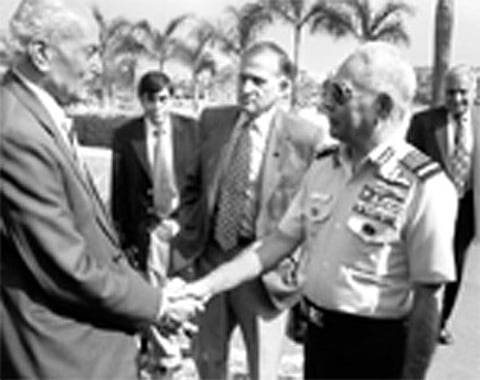

HYDERABAD: ‘How can India become a great power, especially when faced with threat from terrorists and unfriendly neighbours?’ That was the theme of a two-day national seminar on ‘Transformational Initiatives to Achieve Regional Power Status by 2025’ organised by the College of Defence Management here today.
A host of distinguished persons, including Air Chief Marshal Fali Major, former media adviser to the prime minister Sanjaya Baru and former chairman of ONGC Subir Raha, spoke at the seminar.
The Chief of Air Staff, in an interaction with the press later, said that there were lessons to be learnt from the Mumbai terror attacks with regard to internal security.
“Though terror should not be tolerated, we cannot go to war with any nation,’’ he said. When pressed further whether armed conflict with Pakistan was imminent he said the government would make that decision and the armed forces would obey the orders and “are always prepared for any eventuality’’.
Commenting on India’s biggestever defence purchase of 126 fighter jets worth Rs 42,000 crore, Major said the technical evaluations were over and “we will go to the next stage’’. He disclosed that 80 medium light helicopters had been bought from Russia.
In his inaugural address the air chief marshal listed India’s objectives for the period till 2025: continuance of a democratic polity, sustained economic growth and indigenous technological prowess. He also called for self-reliance in the defence sector.
China figured prominently at the seminar, much more than Pakistan or the USA. Virtually every speaker mentioned China. Sanjaya Baru said that India had to engage the Arab world in order to defeat terrorism and secure oil supplies as also the South-East Asian nations and Japan.
Rahul Roychowdary of the International Institute for Strategic Studies said that the world was moving from unipolarity to multipolarity with the decline of the USA and the rise of Asia, particularly India and China.
He also warned of an emerging arms competition in Asia with the Chinese navy and air force being in an expansion mode. Prominent journalist Indrani Bagchi talked about the role of soft power, which she defined as the attributes of a country that make it attractive to others. In India’s case soft power constituted its vibrant democracy, Bollywood, India’s economic success, spirituality etc.
The crux of Subir Raha’s argument was that India had to shake off its bureaucratic sloth if it was to compete with China for scarce energy resources around the world.
Securing oil was the key to India’s economic prosperity, he said.