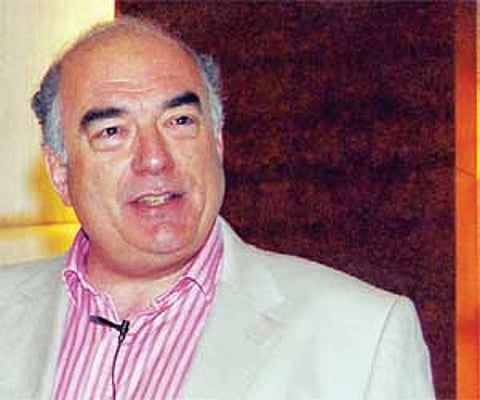

HYDERABAD: As children, we all love to play on the seashore watching the waves roll on to the sand. Simon Boxall wanted to do more than just gape at the sea. He decided that he needed to know everything about the ocean and the tides. Today, a professor in Oceanographic Studies in Southampton University, Dr Boxall is trying to simplify the muddle of climate change which is the greatest threat to mankind.
Boxall was in town to deliver a lecture titled From clues in Arctic to impact in India to spread awareness about climate change. He is now all set to travel from the Atlantic Arctic, through Siberia, to the Pacific Arctic - a voyage that will pose several challenges.
In an exclusive interview with Expresso, Boxall shared some of his thoughts about the emerging trends in the climate change studies. “People always respond to situations when they are associated with a sense of immediacy. But climate change and its adverse effects present a gradual threat like slow poison. Unless we start taking pre-emptive measures, we will not be in a position to handle the future,” he said.
Unfortunately, he added, most of us associate global threats with terrorism or other conflicts and fail to understand that climate change also deserves equal amount of attention.
Asked if it was part of the ‘White man’s burden’ to spread awareness about global warming, he quickly reacted saying that it is a problem of the entire world. “It is true that the industrial revolution (England), political revolution (France) and bureaucracy (Germany), which happened within a span of 20 years in the west have set the tune for the entire world, which started imitating them in certain ways. But we have to repair the damage that has happened after these developments,” he explained. Boxall stressed that this is the time to focus on sustainable development.
Explaining the gravity of the situation in India, Boxall pointed at the Mumbai floods, deteriorating agricultural production and drastic changes in the monsoon cycle are the cases in point and said: ``The worst part of the Mumbai floods is that days after the rainfall stopped, the water did not clear up due to the plastic covers that obstructed the flow of water.” And how does one study the climate change, about which we have bare information of few decades? “Human history is miraculously etched on the tectonic plates in the deep sea.
With the help of carbon dating and other procedures it is possible for us to reconstruct history with accuracy,” he said.
Boxall says that mankind’s knowledge about oceans is only 10 per cent. Every year, we discover 2,000 new species in the ocean and the amount of knowledge is increasing, he says with a childish expression conveying his enthusiasm in the subject.
As part of the Cape Farewell programme, Simon is working with artists, writers and musicians such as Vikram Seth, McEwan, Antony Gormley, KT Tunstall and Jarvis Cocker.