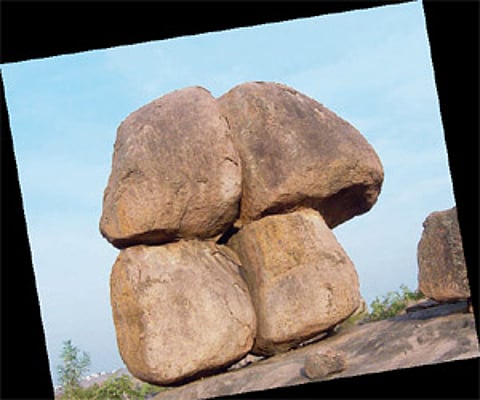

1. Fakhruddingutta (Rocks around Dargah Fakhruddin Baba Aulia), Sheikpet 2. Moula Ali (Rock of Dargah Moulali), together with two adjacent hillocks (Dargah Hazrat Khadme Rasool and Bibi Dargah Kohe Batul) 3. Sentinel Rock, near Moulali Rock 4. Skull Rock, HiTec City, opposite TCS 5. Hamburger Rock, Gachibowli, in NITHM.
6. Pahar-e-Shareef 7. United-We-Stand, Gachibowli.
8. Pathar-Dil, Gachibowli, in campus of Maulana Azad Urdu University 9. Rock on which Dattatreya Temple is situated, Asifnagar 10. Allabanda Hill, Sitarambagh 11. Gangabowli-ka-Pahar, Gangabowli 12. Rocks around Ghaar-e-Mubarak (Bara Imam Gutta and Sakirgutta), behind Taramati Baradari 13. Rocks at Peeran Shah Wali Dargah, near AP Police Academy 14. Rocks near Shamirpet Lake, especially Venkateshwaragutta Temple Rock (north of Lake), Rocks in Jawahar Deer Park (south of Lake), Rocks in Shamirpet Reserved Forest (south of Lake) 15. Ridge behind Malkam Cheruvu, Shaikpet.
HYDERABAD: Employee whose work place is located in the HiTec City, drives past by the Skull Rock, a rare rock formation near the Cyber Pearl on his way home everyday. He sometimes gives it a second glance but then he has other things to think about than rocks.
A natural rock formation in the vicinity of his office does not even cause him to raise an eyebrow.
Uma Shankar is not alone.
While most Hyderabadis are aware that their city boasts of some unique rock formations, very few know their names and locations or the fact that they are being destroyed systematically.
Beautiful rock formations like the Hamburger Rock, Mushroom Rock, Pathar-Dil and United-westand rocks in and around Gachibowli and many more in other parts of the city go unnoticed.
Some of these outstanding products of nature do not catch the normal commuter’s eye but are exposed to the cruel human interventions like quarrying and construction work.
Even as the Hyderabad Metropolitan Development Authority (HMDA), after acting upon representation from several concerned citizens and civ- il society groups, has notified these rock formations as Heritage precincts early this year, little has been done to implement protection rules.
“The Government issued a GO in February itself bringing them under the purview of heritage regulations. All the regulations are confined to paper, as they have not proceeded further on the real grounds,” Save Rock Society Secretary Frauke Quader told Expresso. Let alone implementation of the regulations, Frauke said, most of the rock formations are not marked by the HMDA officials till date.
“The best part about the municipal administration in our city is that they have a separate wing for heritage conservation, unlike many other cities in the country.
But the sad part is that nothing much has been done on the conservation front of the declared precincts,” she expressed.
Stressing on the demarcation of the rock formation sites, another Save Rocks Society activist E Satyaprakash said: “Apart from the regular Save the Rocks walks and awareness programmes held in schools, these sites should be demarcated immediately. If we distinguish them and mark them as Heritage precincts, it seeps into the everyday lives of the people and they would be more aware of the rock formations.” Satyaprakash said he hoped that the officials concerned would soon implement conservation rules.
A group NGOs have submitted a total of 16 sites, which need to be earmarked as Heritage precincts out of which the HMDA officials approved 15 sites. These 15 sites are in addition to the earlier declared nine sites in 1997.
However, when contacted, HMDA Heritage Conservation Committee officials said that they have been busy with several other things and would implement these rules ‘soon’. “We are carrying out a feasibility study and there are many factors in play before we start the work on ground,” an HMDA official said.