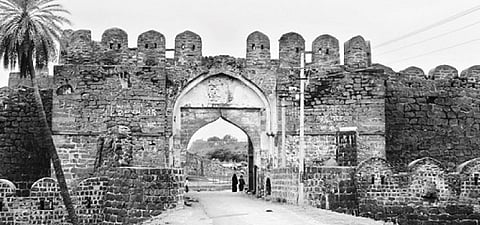

It was in the 609th Urs of the Sufi Saint Hazrat Khwaja Bande Nawaz that I got an opportunity to see another fortified city, but this time in the heartland of Hyderabad-Karnataka region. Wading through jostling crowds at the dargah, where thousands of Muslims and Hindus from India and abroad were attending the five-day festival with great fervour and festive spirit, I decided to take a look at one of the earliest Islamic structures built in this part of country, the Gulbarga Fort.
Making my way on dusty, back breaking roads on a hot day, I was expecting to see the best of Bahamani architecture just like the Bidar Fort. But alas! The whole place was in ruins except for a few buildings like the Jama Masjid, Ranamandal, the innumerable towers with guns, etc. However, the view from the top of the entire city made up for all the disappointment.
The massive Gulbarga fort is considered one of the earliest examples of Islamic architecture in Karnataka. An existing structure, it was fortified by Alauddin Bahamani when Gulbarga became the capital of the Bahamani Sultans. Within the crumbling fort, one can see a number of ancient structures including massive buildings, mosques, temples, stables, ammunition dumps, carriages, towers, guns, and long courtyards. But, the once majestic fort has been reduced to a dilapidated structure, as only the semblance of these buildings are visible today.
With the establishment of the Bahmani dynasty in the Deccan region in the 14th century, the fort became the epitome of the impressive architectural style of the Persians which can be seen in the Gulbarga fort. The Bahmanis built mosques, arches, gardens and palaces within the fort complex and lately, the Archaeological Survey of India has been carrying out conservation work including improvement of the gardens. In fact, a distinct Indo-Persian architectural style came into existence after the establishment of the Bahmani dynasty in the Deccan region.
As other forts in India, this fort too was originally built by a feudal lord, Raja Gulchand of the Warangal Kakatiyas. The fort is based in an area of 0.5 acres with a peripheral length of three kilometres and is well fortified with double fortification. A 30-feet-wide moat surrounds the fort, demonstrating the Sultans’ bid to secure the complex. One of the most well-preserved structures are the towers mounted with guns which are more than 25-feet-long.
The mosque built on the lines of the Great Mosque of Córdoba in Spain is a must-see. Built to commemorate Gulbarga as the capital of the Bahmanis, the mosque has five large domes, 75 small domes, 250 arches, no open courtyard, and unusual dimensions. Most of the buildings here display the distinctive Persian architectural style and are a pleasure to see for an art lover.
