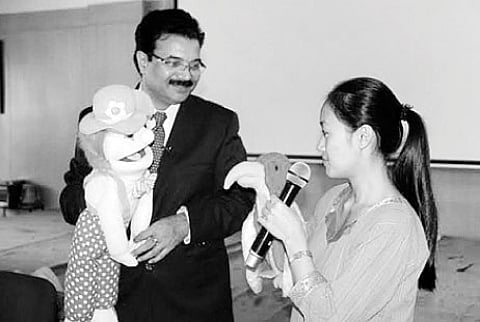

HYDERABAD: With an aim to enhance teaching skills, Centre for Cultural Resources and Training conducts various kinds of sessions, three to four times a year.
This particular workshop that is being conducted by noted ventriloquist and puppeteer GVN Raju works in the favour of children and their learning.
“It is a regular programme and I have been coming here for the past 17 years. Each session has a different set of people, with teachers and lecturers coming in from all over India. They are sent by various education centres and they undergo training in various skills,” informs GVN Raju.
And the approach he uses is his strongest point, puppetry.
“The workshop is named Role of Puppetry in Education for elementary school level teachers where they are introduced to the finer nuances of puppetry and how this art form helps in making concepts more impactful for children,” he says.
An art form that works as a teaching aid for children, especially at the elementary level, Raju says it makes it more amusing for them.
“Considering the attention span of kids that age, it is quite influential. It makes them understand and also remember concepts for longer while they have fun,” he explains.
While using a puppet may be impactful, the way it is portrayed and the kind of puppet one picks up is also quite important.
“From the various types of puppets – from stick, bag, ball, socks, finger and the traditional types, you can pick up any one. But the challenge is to convince those young children. This can happen only when you can modulate your voice that syncs with the puppet you picked up,” he elaborates talking about how it can be used in a classroom.
This leads to little or no deviation among the kids and it works well. It is an advantage because they are in their foundational years.
“Facial expressions and dramatisations lead to quick learning,” he adds.
The training session is planned in such a way, that teachers get a glimpse of all these factors. “First, I give teachers puppets and ask them to demonstrate a concept that they would deliver in class. Based on how they do, I give them feedback,” he shares.
Picking up an instance from the session, he says,” If a Maths teacher has to explain two plus three equals five, rather than saying it directly, it becomes more effective when they say two plus three equals six in the voice of a younger person or that of a student’s and then correct it,” all in a voice that is modulated appropriately.
Apart from all this, the ventriloquist cum mimicry artist who is a trainer by profession delivering skill development programmes at various places says that teachers need to be patient and investing.
“I keep telling teachers that they should try and be the best and for that they need to invest a little money and time,” he advises.
