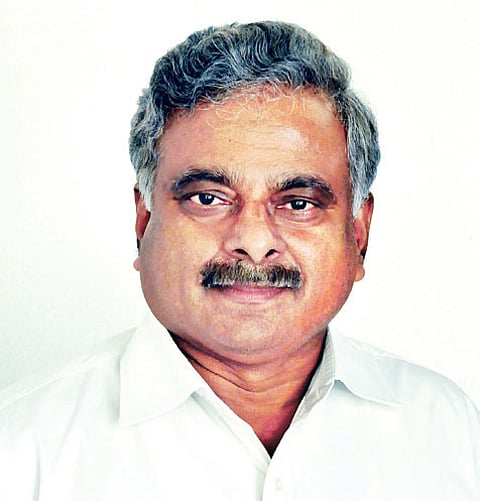

The Rajiv Gandhi University of Knowledge Technologies (RGUKT) recently won a national award for its contribution in rural education. Express spoke to Prof. Ratnam V Raja Kumar, vice-chancellor of the university about the ICT-based teaching methods and its other innovative initiatives that are being implemented in the university.
Excerpts Recently the RGUKT won a national award for its contribution in rural education. Can you brief us about it?
Yes, we have recently received a national ward at the eighth NTA ICT World Communication Summit and Awards for our ICT-based teaching methods. We have introduced this system in 2010 where we started using advanced technology in teaching. Video conferences, online study material have been introduced as part of it. Most of the teaching is done on the computer itself. But we have also made sure that at the end of every class, the students will have an interactive session with the teachers.
How many students have been trained in this method so far?
We have introduced it for our very first batch where we had total of 5,400 students across the three campuses. After the success of first batch, we have decided to continue it for the 600 students in the second batch as well.
How successful the method was?
The numbers alone can define their success. Out of the total 5,400 students from first batch, 1,000 students have got campus placements. Another 600 students have been placed in the current campus placements which are still going on.Most of the students in RGUKT are from rural areas. So, has it been easy for them to operate computers?
Yes, 90 percent of our students are from rural areas, but they had no problem in handling computers. In fact, learning English was the biggest challenge for them. Though most of them did not know even how to read and write English when they joined, now all of them are fluent English speakers.
Does the curriculum also include research?
There is lot of emphasis on research here. In fact, RGUKT is one of the very few universities where the students get to work on their own research projects in the graduation level. Currently our students are working on various topics like cloud computing, intelligence manufacturing system, robotic technology and cyber security.
As the VC of the university, do you find any challenges?
We have no regular faculty here. We need permanent faculty in all three campuses. So far this is the only bigger challenge for us. After the bifurcation of the state, can we expect any changes in the admission process?
Right now I can’t comment on this issue, because it is under the control of both state governments. But the decision will be out much before the SSC exams are conducted.
