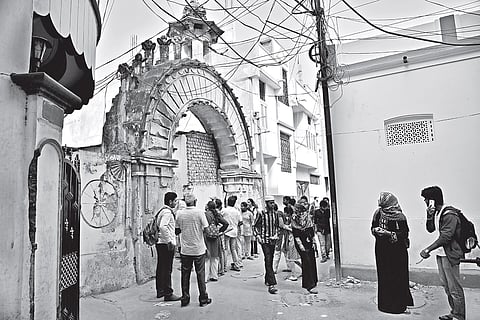

HYDERABAD: When Sufis made the deserts of North West India their home as they landed in Fatehpur Sikri. To explore the city and its shrines a group of Hyderabadis went to the Old City early on a Sunday morning.
The first stop was Darushifa. Darushifa lies in the South part of the city near the banks of river Musi and was built some 400 years ago by Quli Qutb Shah. The mosque of Darushifa is more famous and crowded mostly on Fridays. Earlier there was the hospital which has now been shifted. But enter its premises and you get to see ashoor khana with devotees clad in black and eating early morning breakfast of a type of tandoori shermal they call tabarruk.
Dargah is a shrine built on graves of saints and Sufis. While Ashurkhana is a hall for Shia congregation especially during the month of Muharram commemorated for the war of Karbala and those who were martyred. As the walk organized by Hyderbad Trails proceeded more people joined with cameras and notebooks.
After crossing Chatta Bazaar which got its name from the umbrella bazaar that it used to be. As you cross the closed shops you still get a faint smell of printing ink hanging in the stale air of the previous night. This place used to be a market of perfumes some 400 years back. And to witness its hullabaloo there is a 455-year-old kamaan (a huge entrance place sans any door). Move into the intricate lanes of Irani Galli you get to see a huge door with old-style brass knobs. At the top is written in Nastaliq 1226 hijri as its date of formation.
Well, a light knock on the door and all you see is a huge Indian jujube tree and a black shalwar hanging on the clothesline. It’s barely 8 in the morning and the folks of the household have just woken up. What makes this place so special? Well, inside the courtyard on righthand side stands a 200-year-old ashurkhana in wooden frames and colourful stained glasswork. This is the personal property of Moosvi family whose ancestors had shifted to Hyderabad some 250 years ago. They were carpet merchants from Iran. The lady of the house and in-charge of ashoor khana Shahar Bano tells us, “My great great grandfather Mir Qurban Ali constructed this ashoorkhana in the year 1811.” And how exactly does this property stand sturdy after two centuries and is still bright in paint. “Because we take care of it ourselves. It’s our family legacy.” She then takes us inside. On a huge table-like elevation that occupies most of the rectangular room space there are small approx 2 feet*3 feet replicas of small shrines are kept. Peep inside and you see the courtyard, balconies, staircases and even tiny cots with brass goglets. The domes of these structures are onion shaped and you realize they have a connection with Central Asia.
A closer look and you see these are shrines and mosques. One shrine is of Imam Reza in Mashad, Iran for shiites. It’s notable with its golden dome and courtyards. The other shrine next to it resembles Al Askari Mosque shrine of tenth and eleventh Shia Imams. Another golden dome next to it is replica of a shrine based in Iraq. Says Shahar Bano, “My great great grandfather used to see in dream that he’s building these structures. He took it as a divine vision and started working on it.” The lady then sat along with other family members and began singing marsiyah: an elegy for those martyred in war of Karbala in the month of Muharram which is incidentally the New Year for Mohammedans all over the world. Right in the corner of the ashoor khana is akhara with sticks and spears; akhara is a place where Shias do pseudo-fight with one another with sticks. Since this is the month of Muharram the walk was completed without any music as a mark of respect to the Shia community.
But the marsiyah at the ashoor khana has its own sad music reminiscent of old eons gone by.
