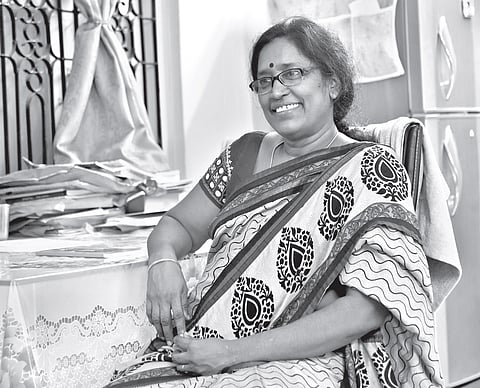

HYDERABAD: Back when Shanthi Prabodha was a teenager certain instances stirred her. “My neighbour’s husband used to abuse her and send her off to her parents’ place at least once a month. The lady would pack her bags and leave the house with her children. He would use up the money and had nothing left to provide for them,” recalls former journalist, social worker and writer. This was back in the 70s and since then her mind always paid attention to the way women are told to lead their lives, everywhere. “Wherever you go, women are the ones who suffer,” she points out.

After a brief stint as a journalist, where she spent her time writing on a number of women’s issues, the 53-year-old took up the task and joined the cause to eradicate the centuries-old social evil, Jogini system.
“I had interviewed Dr Hemalatha Lavanam, founder of Samskar. She has been an inspiration since then. Much later, I was asked to join the cause when I was in Nizamabad,” recalls
Shanthi.
The system that has been prevalent across the country, where women from the lower or backward castes are married off to their local deity. They become the wives of Gods only to fulfil the sexual needs of upper caste men in the society. The ceremony, at times, is performed on new-born babies.
“They are promised to the God. Once they attain puberty, they start providing services,” informs Shanthi.
While Samskar started work in Nizamabad in 1988, Shanthi joined them in 1993 as the programme coordinator for the Jogini Reformation Programme. “We conducted a number of programmes and close to 2,200 Jogini families benefited from it,” shares Shanthi.
Going back to the first encounter with the Joginis, Shanthi tells us, “We went to meet them and they were reluctant to step out. They asked, “Mamalni kalavadaniki aadavallu enduku ocharu? Magavallu kada ravali? (Why have a group of women come to meet us, shouldn’t it be men?). I was surprised. That was their world.”
After multiple counseling sessions, frequent meetings with their families, we could bring them out of that bubble. “We would sit with them in their homes, ask them for water and drink. It gave them a sense of confidence, that they are accepted as one of us,” recalls the writer.
Reformation programmes ensuring that government schemes reach the people apart from educating the next generation of girls.
“The idea was to show them all the available options. From education, available scholarships, job opportunities for children, providing them with lands for agriculture and so on,” explains Shanthi.
While working with the children and the Joginis was a satisfying task, the journalist in Shanthi needed a boost. At one of the activities where she was training children in documentary making and the result led her to write the only available book on the social evil.
“We asked children to come up with ideas for a short documentary and one group came up with Joginis. I was surprised and also worried. They made a good movie that was later screened internationally. That was the moment I decided. I have so many instances, so many experiences in my mind, I decided to put it on paper,” she shares. That is how ‘Jogini’ was born. “I wanted to write a story, but it didn’t stop there,” she adds. The second edition of the book was published in the year, 2010.
“It received several awards. I was in my own world, putting my thoughts on paper. It was only when I went to receive these awards that I met with writers and the writing circles,” says Shanthi who is currently the national coordinator of Praja Swamika Rachyithula Vedika. Jogini won the Kandukuri Navala Puraskaram in the year 2014. It was also awarded the Uttama Novel Award in the year 2007 by Telugu University.
“It was a pleasant surprise. Right now, especially about the time I spent with children,” she signs off, with a grin.