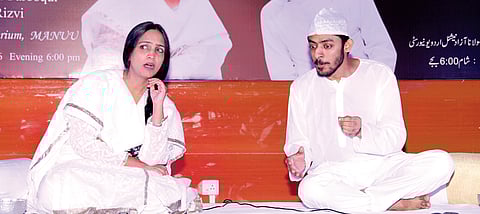

HYDERABAD: It takes a Princess Scheherazade to recite different tales every night with a cliff hanger and it takes a dastango to tell a tale which can end and begin anywhere. While ‘Dastan-E-Alf-Laila’ is alive in documentation, the art of dastangoi once lost has been revived in not just one forms but various forms. This oral art of Urdu story-telling is fascinating with its battles, fairies, genies, kings, queens, trickery and of course magic. The magical tales surpass JRR Tolkeins and GRR Martins of today. The only difference is that the former is theatre at its minimal and doesn’t require the elixir of silver screens or exquisite prints in leather bounds. One such spell was cast on the audience of Hyderabad recently at Maulana Azad National Urdu University (MANUU), Gachibowli when team of Dastangoi travelled all the way from the Delhi to the City of Pearls for performing ‘Dastan-E-Amir-Hamza’ at the University campus. And the best part is that the raconteurs don’t just tell dastans of Amir Hamza but of ‘Alice in Wonderland’ and ‘The Little Prince’ as well.
Dastan in Deccan
Before the rise of Islam in Arab countries, dastangoi flourished. They were called Samer. Even the cavemen can be called dastango. Oral tradition is from the time immemorial, there’s no documented proof.
Writer, revivalist and director Mahmood Farooqui writes on his blog: “By the sixteenth century, versions of the Hamza story had begun to circulate in India. Mentioned first in the Deccan courts, the story reached its artistic apogee in the court of Emperor Akbar.” Historians argue that the written version came first in Deccan.
Prof Naseemuddin Farees who teaches Deccani literature at MANUU tells us what the city historians couldn’t. He informs, “Poetry in dastan form flourished in Bahmani Kingdom who patronised Urdu language much. In documents there’s mention of poet Fakhar Deen Nizami who wrote dastans in poetic form. (circa ?) Even in Adil Shahi period of Bijapur the art form was patronised.”
He further adds, “During Abdullah Qutb Shah period, the seventh ruler, the poet laureate in his court Asadullah Wajhi wrote first dastan. This was Urdu’s and Dakhani’s first dastan in prose on request of the king; it’s named ‘Sab Ras’.” Written in 1635, ‘Sab Ras’ is based on a Sanskrit drama by Krishna Mishra. Wajhi took refrences from Persian version of the same. He writes that there were many courtiers in the King’s court. He mentions that there was a dastango as well. However, the art form declined later. King Tana Shah the last ruler of Golconda didn’t patronise this art form because it was the sunset period of the Deccan Kingdom.
Some of the manuscripts of these periods still survive in Salar Jung Museum Library, Idarah-E-Adabiyat-E-Urdu and Oriental Manuscript Library. Some manuscripts have been printed and edited in India and Pakistan.
Dastangoi as bare minimum theatre
We saw both the dastangos Ankit Chadha and Poonam Girdhani set the stage on a small chowki covered with spotless white sheet. The performers, too, were clad in the same pristine hue. From time to time they drank from two silver cups put before them. They started with the most famous story ‘Dastan-E-Amir-Hamza’.
The beauty of dastan is that it can begin from anywhere and end anywhere. Both the performers narrated the life and times of Amir Hamza and his childhood friend Amar who later becomes world’s famous aiyyar or trickester. It was important to note how ten years back the revivalist Mahmood Farooqui had brought in the flavour of the bygone centuries in rhyming lines like:
Maulvi ney jo gardan uthhayi Toh cheekhti chillati biwi nazar ayi
At the event, the first part of the dastan was on mischievous deeds of Amar aiyyar directed towards his ustad in madrasa. Surprisingly the tale, being narrated from 7th AD, appeared similar to what we heard or read in children’s magazine about the same. Explained Poonam, “Many of the dastans are passed on from generations to generations and that’s how some of them appear almost identical.”
The next dastan was from Tilism-E-Hoshruba about Amar aiyyar’s tryst with Afrasiyab, the king-sorcerer and master of a magical world built with thousands of castles guarded by genies and demons. Tilism-E-Hoshruba epic is said to be longer than ‘Mahabharata’.
So how does an oral story win over the printed versions? The tallafuzz, facial expressions and the dexterous art practised by the narrators is what keeps them hooked to dastangoi. In daily lives we don’t use such archaic Urdu, but still the artistes did it with peerless dexterity.
Share both of them, “Urdu scholar Shamsur Rahman Farooqui, the revivalist of dastangoi, is always present at the practice sessions. If the passages are really difficult he explains them. We fondly call him bade abbu.” Poonam has been a theatre artiste for the past 20 years, while Ankit has been a dastango for more than five years.
Documentation
For a century Munshi Nawal Kishore kept publishing volumes of dastans in Urdu. Apparently there were 46 volumes of Dastan-E-Amir-Hamza consisting of 1,000 pages each. Two colleges in India also came up with documentations. At Fort Saint George College, Madras, dastans were written in Dakhni. In Calcutta, at Fort Willliam, the munshis used to pen the dastans. Most of them were translated from Persian.
New adaptations
Created and directed by Mahmood Farooqui this ancient art form is not limited to the old stories only. With time stories, too, change. That’s how the artistes have started performing dastangoi for ‘Alice in Wonderland’ and ‘Little Prince’. But these stories in print versions complete with beautiful illustrations have been loved for years. So how does a dastan beat the printed world and why would people come to listen to what they have already read? Says Darain Shahidi a senior journalist and dastango based in Delhi, “Any oral tradition isn’t original. It was born somewhere and expanded all around the world; there lies its popularity. What becomes important is how the dastango is telling the tale and what language s/he is telling the tale in. This enamours the audience.”
Interestingly, these works of literature that are almost cult classics are told by the raconteurs in contemporary Urdu and not in archaic version. But is dastangoi told in other languages as well? Explains Darain, “In 1846, when Munshi Nawal Kishore had taken keen interest in publishing the dastans, Amba Prasad Rasa included Brajbhasha in dastangoi which flew with exquisite charm while describing a woman’s beauty. In the same dastan you hear couplets by Hafez and Bedil.Wahi bhasha original hoti hai jo popular hoti hai.”