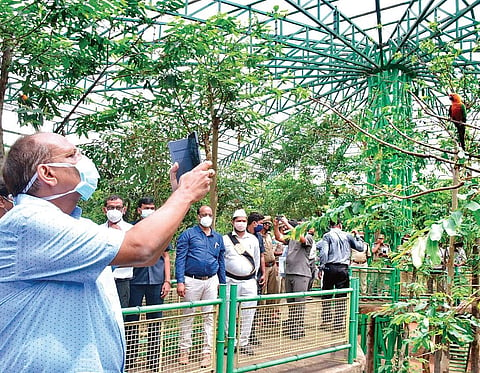

HYDERABAD: Miyawaki Parks or mini forests will now dot all Urban Local Bodies (ULBs) in Telangana, including six under Greater Hyderabad Municipal Corporation (GHMC) limits. The parks will be the first of its kind to come up in the ULBs during the proposed Telangana Ku Haritha Haram (TKHH). According to GHMC officials, the State government has proposed that every ULB have at least one such park. Chief Secretary Somesh Kumar issued instructions to ULBs in this regard on Saturday.
What is the Miyawaki method?
Miyawaki is a technique pioneered by Japanese botanist and plant ecology expert Akira Miyawaki to restore mini forests in populated areas, similar to urban afforestation. Unlike the traditional method of planting trees where sufficient space is provided between each sapling, the Japanese method advocates planting of more trees in small spaces with an aim to improve the urban landscape.
It allows forests to have improved greener surface area as compared to monoculture (traditional) plantations. In traditional plantation techniques, one sapling is planted at an average distance of 150 sqft from each other, whereas the Miyawaki technique can support 50 saplings within 150 sqft area.
The approach is supposed to ensure that plant growth is 10 times faster and the resulting plantation is 30 times denser than usual. According to officials, the Miyawaki technique brings together a spectrum of processes that needs to be followed with precision, from preparing the soil to managing mature sand. Identifying native vegetation that is adapted to the climate and rainfall of an area is the first step to creating a Miyawaki forest and extensive surveys are required to identify the right species.
