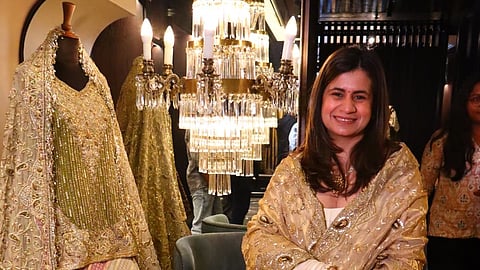

If you remember the wedding scene in Dhurandhar, especially the song Shararat, the grandeur of the costumes would have been hard to miss. Building on that on-screen buzz, Divani, founded by Sanya Dhir, has now arrived in Hyderabad with its flagship store in Banjara Hills. Since its inception in 2013, the label has focused on reviving the revered art of zardozi, celebrating heirloom traditions with a contemporary lens.
Beyond couture, Divani extends its vision through The Zardoz Project, a cornerstone initiative dedicated to preserving and revitalising the craft. Through this, the brand supports over 500 zardozikars across traditional craft clusters, creating meaningful and sustained opportunities while safeguarding a centuries-old art form. CE spoke to Sanya about bringing Divani to Hyderabad, collaborating on Dhurandhar, and the importance of preserving heritage and culture.

Excerpts
Tell us about the idea behind Divani.
Divani is a celebration of the craft, couture, and culture of Hindustan. At its heart lies the nuance of zardozi, which is what we honour through the brand. Hyderabad, with its deep sense of culture and tehzeeb, understands handcraft beautifully. Bringing Divani here felt like a homecoming. A part of the brand has always belonged to this city, so opening our flagship here was only natural.
The store feels opulent. Take us through it.
We wanted the space to unfold gradually, almost like a story. It was designed by Habitat Architects, led by Zafar Maqsood Chaudhry, who also created our Delhi flagship. He has a strong understanding of spatial flow, so we built in a sense of mystery — one space opening into another, never revealing everything at once. The bridal couture lounge is a by-appointment space showcasing intricate work in copper, silver, and gold. That sense of opulence and discovery runs throughout. Beyond couture, we also work with interiors — ceilings, panels, soft furnishings, and art. One of the most special additions here is our restoration vertical. Hyderabad, with its Nizam heritage, has so many heirlooms. People can bring in family pieces — sarees or dupattas — and we restore them to their original glory. We don’t recycle or repurpose; we preserve. If it’s a saree, it remains a saree. That integrity is very important to us. Alongside this, we offer bridal wear, festive collections, accessories, and iconic pieces like the khada dupatta in its authentic form — no shortcuts, no reinterpretations.
How did your journey with Divani begin?
For me, Divani is everything but fashion. It’s about restoring heirlooms, reconnecting with our roots, and preserving culture. Over the past 11 years, our focus has been on storytelling, every garment carries a narrative and deeper meaning. It began with a 150-zardozikar craft project in Lucknow, and from there, Divani was born. More than the brand itself, people often ask how zardozi came into our lives. It’s a Mughal craft that many once considered outdated, something their grandmothers wore. We wanted to change that perception, especially among younger audiences, by returning to original cuts, authentic silhouettes, and traditional craftsmanship. Heritage isn’t outdated, it’s timeless.
Why the name ‘Divani’?
Because this is madness! (laughs) You have to be a little mad to do something like this, especially in today’s fast-paced world. Each piece takes three to six months to create. Nothing is off the rack; everything is made to order. It’s slow luxury, understated and intentional. Choosing patience, craft, and authenticity today requires a certain kind of obsession — divani-pan.
Tell us about your collaboration with the film Dhurandhar. How did it come about?
We’ve consciously stayed away from film associations unless they truly align with our ethos. Dhurandhar came to us organically. We weren’t designing costumes; we were presenting pure craft. The team respected that, and each character was styled with authenticity in mind. Whether it was subtle zardozi detailing on a collar for Arjun Rampal’s look at the wedding or a Balochi-style ensemble for Ranveer Singh, everything was rooted in character and narrative. It became a deeply collaborative process with the costume designer and the director Aditya Dhar.
Is there a piece in the store that’s special to you?
Yes, my great-grandmother’s saree. It featured a technique called motichoor, inspired by the tiny grains of a motichoor laddoo. Recreating that and bringing it back to life was incredibly special. When we launched it as a collection last year, it sold out completely. Seeing something over a hundred years old being appreciated again, not just admired but valued, is deeply fulfilling. It reinforces why we do what we do.
Do you have a favourite colour palette?
Yes, charcoal. It’s inspired by the tones seen in Raja Ravi Varma’s work. About eight years ago, we collaborated with the Lakshmi Vilas Palace, thanks to Her Highness Radhika Raje Gaekwad, and that’s when this palette became deeply embedded in Divani. Since then, it has remained one of our most defining colour signatures.