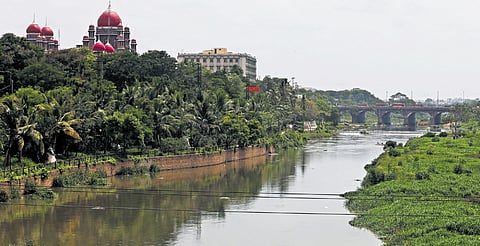

HYDERABAD: With the state government determined to rejuvenate the Musi, the Musi Riverfront Development Corporation Limited has put in motion a plan that is technical yet ambitious.
The plan involves intercepting and treating sewage before it enters the river along a 34-km stretch from Bapu Ghat to Gowrelly. It forms part of the larger MRDP, which aims to transform the river from what is now akin to a drain into a usable urban asset. For decades, the Musi’s decline has been driven less by industry and more by the steady inflow of untreated domestic sewage through a network of nalas. The new plan seeks to address this flow at its entry points.
At key junctions where nalas meet the river, interception and diversion (I&D) structures will be installed to capture dry-weather sewage and redirect it, either by gravity or pumping, into a parallel network of trunk sewer lines. These mains will run along both banks, beyond the highest flood level, to remain functional during heavy rains. Officials describe the approach simply: prevent untreated wastewater from entering the river.
Instead of relying on a few large plants, the plan proposes a chain of decentralised sewage treatment plants (STPs) located near major nalas. These modular and compact units may be built underground or vertically, depending on space constraints in dense urban areas.
By treating wastewater closer to its source, the system aims to reduce pressure on centralised infrastructure and improve efficiency. The treated water will meet prescribed environmental standards before discharge or reuse.
The project also involves detailed mapping using Total Station instruments, DGPS and drone imaging to ensure accurate, ground-verified designs. It draws on existing studies, including the Comprehensive Sewerage Master Plan by the Hyderabad Metropolitan Water Supply and Sewerage Board, along with inputs from GHMC and HMDA, to identify gaps and overlaps before finalising the Detailed Project Report.
Funding is expected under the National River Conservation Plan. However, execution may be challenging as the river corridor is occupied by pipelines, power lines, dhobi ghats and informal dumping points, which will need to be relocated or integrated.
If successful, the project could change how Indian cities tackle river pollution—not by treating it downstream, but by stopping it at the source.
Unhindered flow
34-km Bapu Ghat to Gowrelly stretch identified as priority zone
Sewage to be intercepted at nala entry points
Trunk mains planned beyond flood levels on both banks
Modular plants to treat sewage close to source
Funding for the project proposed under NRCP
