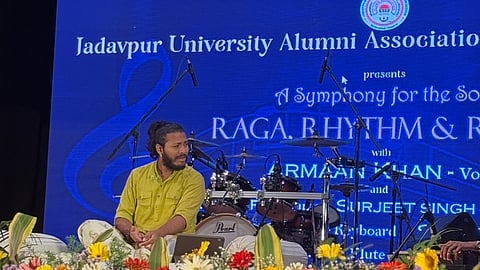

On a warm evening in Hyderabad, Ravindra Bharathi became a space where time slowed and music spoke beyond words. Raga, Rhythm & Roots, presented by the Jadavpur University Alumni Association Hyderabad, carried the weight of legacy as Armaan Rashid Khan took the stage — not just as a performer, but as a torchbearer of Ustad Rashid Khan’s enduring musical heritage. With an effortless, playful presence, Armaan drew the audience in, turning them from spectators into participants as the evening gently unfolded. The first half unfolded with a deep, unhurried immersion into classical music with songs like Na Maane Mori Baat and Yaad Piya Ki. Beginning with vilambit, Armaan allowed the raga to take its time, building note by note, inviting the audience to settle into its rhythm rather than chase it.
As he shared in conversation with CE, “Riyaz is nothing special. You sit with one raga and get used to it. Initially, the raga controls you, and then slowly, you start controlling it.” That quiet mastery reflected in his performance — never rushed, never overreaching. Yet, for an artist born into such a towering legacy, the journey hasn’t been without its weight. “It’s always been difficult; there’s this huge legacy,” he admitted, adding, “I just want to create something people can connect with, not make classical music feel like a language they don’t understand.”

That thought shaped the evening’s most striking transition. Just when the audience had surrendered to the depth of classical, the second half arrived — not as a break, but as an expansion. Joined by his band — Sou bhik Lahiri (drums), Surjeet Singh (tabla and percussion), Abhishek Chakraborty (keyboard), Sayantan Kundu (bass guitar), Rick Mukherjee (flute), Sanjoy Das (guitar), and Lalit Sisodiya (harmonium) , the mood turned warmer, lighter, and more immediate. Tracks like Mere Dholna, Gal Sunn Le, Aaj Dekha Hai Tujhko Der Ke Baad, Aaja Re Aa Barkha Re, Teri Yaad Humsafar, audience-demanded Phir Se from Dhurandhar, and Meghashe Aashe, among others, added a contemporary texture while staying rooted in the classical core.
“For me, this is a new concept. I just hope people enjoy it,” he shared before the concert. And they did. If the first half was introspective, the second was connective. The audience leaned in, responded, and somewhere between the notes, the distance between ‘classical’ and ‘contemporary’ quietly dissolved. While he has stepped into playback and contemporary spaces, his foundation remains unchanged. “What my forefathers practiced, I’m still practicing and that never changes.” What also stood out was his love for the stage. “I’m not really a studio person. I love live concerts where I can see people,” he shared — something that translated into a performance that felt alive, responsive, almost conversational.