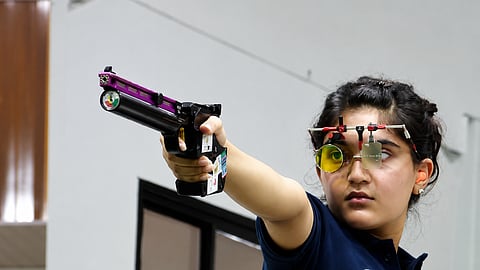

Hyderabad’s golden girl Esha Singh continued her dream run, clinching her second 25m pistol gold of the year at the International Shooting Sport Federation (ISSF) World Cup in Hangzhou, China, after her win at the Munich World Cup in May. A steady hand, a fearless mindset and years of hard work came together. But behind the composed champion were nerves, pressure and countless hours of preparation. In an exclusive chat with CE, Esha and coach Ronak Pandit reveal embracing pressure, learning from setbacks and the mindset that continues to shape one of India’s brightest shooting talents.
Excerpts
What was your first thought after the final shot?
It’s a little hard to say because I don’t remember much. I think I was still somewhere between being in the zone and realising it was over. Of course, I was happy and very satisfied with my performance. My first thought was, ‘Okay, show over now.’
You became the youngest senior national champion at just 13. How do you look back at the journey?
From being that little girl to where I am today, I still think I’m a little girl, but I carried every experience with me. Whenever I had a bad performance, I did feel disappointed, but I never sulked. I worked on it instead. That mindset has brought me to where I am today.
What first drew you to shooting?
I was nine years old, and my father wanted me to take up a sport. Before shooting, I played endurance sports like badminton and tennis. Shooting was the only sport where I thought, ‘This is easy’. You stand in one place and don’t have to run around. I initially tried shotgun shooting, but because I was so young, the gun was too heavy. They later took me to the armoury, and the only thing I could comfortably pick up was a pistol.

What does a typical training day look like for you?
The best way to describe it is that even a sportsperson has something like a 9-to-5 routine. (laughs) I wake up, complete my training session, take a lunch break, return for another session, and then finish with gym work. By the time everything is done, it’s around 5 pm. That’s my usual day.
How do you stay calm when every shot can change the outcome?
I always say I’m not calm at all when I compete. Maybe I look calm because I control my expressions, but inside, I’m not. There are moments when my legs are shaking and my hands are trembling. You simply have to play through those feelings. I’ve experienced those situations often enough to know what they feel like. They’re no longer unfamiliar. I’ve also proved to myself that I can perform despite feeling that way. I think that confidence helps me keep going.
What does it mean to bring such a prestigious medal back to your home city?
Hyderabad has a wonderful sporting culture, and we’ve had some incredible athletes come from here. I also love what sir always says — that maybe it’s in the biryani. I’m really proud to represent my state, especially at the international level. The support I’ve received from my state has been significant. I feel recognised, I feel seen, and I’m truly grateful for everything.
Who have been your biggest inspirations?
Initially, it was my dad because our house was always filled with his rally driving trophies. Later, when I joined Gun For Glory Shooting Academy, I would constantly see photographs of Gagan Narang with his medals, and that inspired me. Another major inspiration was Greek shooter Anna Korakaki. Back then, she was one of the few athletes to win two Olympic medals in a single edition of the Games. She was an incredible shooter, and I even had the chance to compete alongside her. I also watched a lot of Formula One growing up because of my dad. My favourite driver has always been Ayrton Senna. I admired his mindset.
You’ve competed alongside and against some of the finest shooters. How has that environment helped you grow?
The environment is definitely competitive, but I’ve never looked at it that way. Shooting is an individual sport. You’re not directly facing another competitor. You need the maturity to understand that you’re really competing with yourself. Whatever work you’ve put in eventually shows on the scoreboard. You’re not battling anyone else, it’s just you versus yourself.
Was there a setback that changed the way you approached shooting?
I don’t really see setbacks that way. At the end of the day, you’re human, not a robot who can deliver an amazing performance every single time. Sometimes things don’t go the way you want, but maybe that’s also a sign that something needed fixing. It’s better to discover that before an even bigger competition. I always look at those moments as building blocks. Over time, they help make you stronger.
What would you tell young athletes who fear failure?
Not to quit and not to look at everything as failure. Give yourself time to understand how you perform in competition because it’s very different from training. If you truly love the sport, then there’s a passion inside you that’s worth pursuing.
Your coach, Ronak Pandit, has been a constant throughout your journey. Is there one lesson from him that stays with you before every competition?
He talks a lot, so it’s hard to remember just one thing. (laughs) But one lesson has always stayed with me. Before every major competition, he tells me, ‘The title changes, but what you do doesn’t change.’ You simply have to play your own game.
After this landmark victory, what excites you most now?
I’m looking forward to the competitions ahead. We have the Asian Games this year and the World Championship. This time it won’t be my debut, so I’m really looking forward to competing.
Gold built on discipline
Esha has always had an exceptional ability to deliver under pressure. She has good technique, she’s talented and possesses all the necessary skills. But at the end, to win, what you need is the right perspective. Her ability to stay focused on her job and not get intimidated by the occasion is what is quite amazing about her. I haven’t seen a major transformation. I have just seen things get better.
- Ronak Pandit, Coach