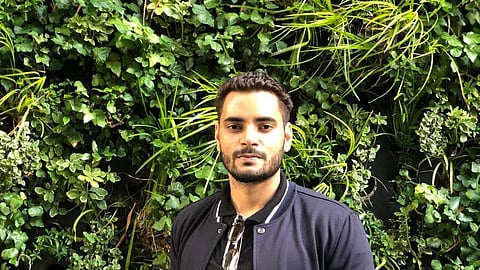

Long before audiences marvel at breathtaking visuals or gripping action on screen, an editor has already pieced together the soul of the story, frame by frame. For RC Pranav, that process begins almost as soon as the camera starts rolling. After honing his craft on over 600 commercials and contributing to acclaimed films like Gully Boy and 83, the editor made his Telugu feature debut with Nagabandham, a fantasy spectacle driven by mythology, action, and cutting-edge VFX. In an exclusive chat with CE, he opens up about sculpting the VFX-heavy world of Nagabandham, trimming hours of footage into compelling storytelling, and more.
Excerpts
Nagabandham marks your debut film in Telugu. How was the experience?
The experience was exciting and a lot of fun. While I had already debuted in Tamil cinema with two releases, this is my first Telugu film. Handling a project of this scale was overwhelming at times, but I had an amazing team and a visionary director. Working with someone of that calibre at such a young age makes me feel extremely lucky. I started editing from the very first day of the shoot, often on the spot. After every schedule, I would assemble the entire block within three days, complete with music and SFX, and present it to the director. Those initial cuts were intentionally longer because I wanted to include everything we had shot before tightening the pace later. I also worked closely with all 10 VFX companies, handling quality checks alongside the director. Every VFX shot first required my approval, then the DOP’s, and finally the director’s, so I was deeply involved in ensuring the narrative flow and visual quality.
What was the most challenging sequence in the film to crack?
The interval sequence was by far the toughest. We had nearly 15–20 hours of footage, and my first cut ran over 30 minutes. It eventually came down to 19 minutes, including a four-and-a-half-minute song. Since the sequence unfolds in one location with multiple characters, intense action and emotional beats, trimming it without losing its impact was extremely challenging. It also marks a pivotal shift in Rudra’s character arc (played by Virat Karrna), making every cut crucial.
Having edited over 600 commercials, how has that experience influenced your approach?
Commercials have been invaluable, especially during the trimming stage, where I believe a film truly finds itself. Advertising taught me to tell a complete story in just 30 to 35 seconds, so I instinctively know how to condense an eight or 10-minute sequence into something far more engaging. At the same time, editing isn’t about cutting everything down. Some moments need room to breathe.
What lessons from editing Gully Boy and 83 helped you while working on Nagabandham?
Every project I’ve worked on, whether it’s a film, commercial, teaser, trailer or music video, has been a learning experience. More than the projects themselves, it’s the people you collaborate with who teach you the most. Every director approaches emotion and storytelling differently. I consider myself a student of cinema because filmmaking is an ocean; every piece of footage, no matter how small, teaches you something new.
Were there any scenes in Nagabandham that changed dramatically?
Absolutely. The original script had several non-linear elements, but we restructured it into a linear narrative to improve the flow. We also removed two scenes that added flavour to the hero and villain but slowed the story’s momentum. Editing also means refining performances. Sometimes, an actor’s first or second take carries a spontaneity that later takes lose, so I often borrow moments from different takes to elevate a scene. My guru, Anthony Sir, taught me to study every frame of the rushes carefully, including the moments just before ‘action’ and after ‘cut’, where some of the most natural expressions appear.
You’ve been nicknamed the ‘world’s fastest editor.’ Beyond speed, what defines a great film editor?
Speed is only a tool. A great editor studies the rushes deeply before making a single cut. The best editing is invisible. If audiences leave the theatre emotionally moved without ever noticing the cuts, that’s the biggest compliment. Film editing isn’t about flashy transitions or rapid-fire effects; it’s about creating a seamless flow where every scene connects naturally.
How do you know when a sequence has reached its best possible version?
Before I even sit at the editing software, I run through multiple versions of a scene in my head while watching the rushes. Once I choose the strongest approach, I fine-tune it on the timeline. Ultimately, I trust my gut. When the emotions land, the performances feel authentic and the pacing is right, I know the sequence is working. Another good sign is when the director watches it and has nothing left to suggest.
What’s next?
My next release is Photographer, a forest survival thriller scheduled for August 7. Beyond that, I’m reading scripts and looking to collaborate with passionate filmmakers who truly love cinema. It doesn’t matter whether they’re established or newcomers. Once I sign a film, I treat it like my own baby and stay with it until release. I simply want to work with directors who are as passionate about the craft as I am. I have zero qualms about proactively reaching out and asking for good work! I just want to collaborate with directors who love the craft as much as I do.
