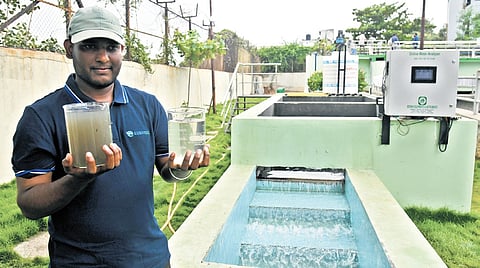

HYDERABAD: Hyderabad Metropolitan Water Supply and Sewerage Board (HMWSSB) is exploring the possibility of deploying Japanese Bio-Lace technology in polluted nalas across the city after a pilot project achieved a 90% reduction in organic pollution.
The first-of-its-kind project in India, implemented jointly by HMWSSB and the Japan International Cooperation Agency (JICA), has demonstrated an energy-efficient and sustainable solution for treating polluted flowing drain water. The 1 MLD pilot plant was set up at the Sewerage Treatment Plant (STP) in Fatehnagar.
Reviewing the project in the presence of JICA representatives, HMWSSB managing director K Ashok Reddy was informed that the pilot achieved a 90% reduction in organic pollution (BOD), an 85% reduction in total suspended solids (TSS) and required no chemical dosing.
Compared with conventional sewage treatment plants, the Bio-Lace technology consumes less than half the power, requires only 10-20% of the land, generates substantially less sludge and operates without chemical additives.
Developed in Japan, the technology has been used to restore more than 400 rivers and waterways. The Hyderabad project, executed by Japan-based TBR Co. Ltd., marks the first deployment of the technology in India for treating polluted flowing drain water.
Ashok Reddy said the pilot had demonstrated a marked improvement in water quality, indicating that the technology could provide an efficient and environmentally sustainable solution for tackling pollution in urban drains. He directed officials to carry out a comprehensive evaluation before examining its expansion to other parts of the city after assessment by the Pollution Control Board.
Reiterating the State government’s goal of ensuring that no untreated sewage enters the Musi River, Ashok Reddy said HMWSSB was working towards treating 100% of the sewage generated in Hyderabad in line with the directions of Chief Minister A Revanth Reddy.
“We are moving fast towards achieving this objective next year,” he said, adding that the Water Board was also examining the possibility of deploying the technology directly in flowing nalas and streams.
