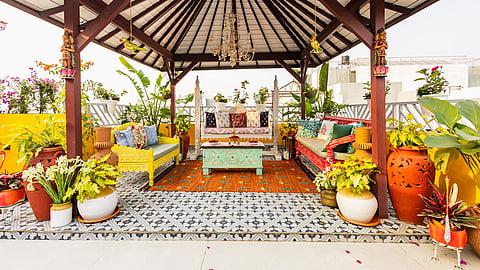

For decades, floors were expected to fade into the background. They were chosen for practicality, durability, and perhaps, a neutral colour palette that quietly supported the furniture above them. Walls displayed the artwork, ceilings showcased dramatic lighting, and furnishings became the conversation starters.
Today, that hierarchy has shifted. Floors have emerged as one of the most expressive elements of contemporary interiors, influencing not only aesthetics but also the way spaces are experienced. From expansive porcelain slabs that resemble sculpted stone to handcrafted patterned tiles that inject personality into a room, flooring has evolved from a finishing touch into the foundation of architectural storytelling.
Designers are increasingly approaching projects from the ground up, recognising that the surface beneath our feet establishes the visual rhythm, emotional tone and spatial flow of an interior long before furniture enters the picture.

“The role of tiles in contemporary interiors has changed dramatically over the past few years. Flooring is no longer considered a purely functional element; it has become one of the strongest design statements within a space. Today’s consumers are far more design-conscious and are actively looking for flooring solutions that combine aesthetics, durability, and affordability,” says Neha Mahajan, founder & CEO of Toyama Floors.
One of the biggest factors driving this transformation is accessibility. Materials once reserved for luxury residences and boutique hotels are now available to a much broader audience, thanks to advances in tile manufacturing. Marble, travertine, hardwood, and natural stone can now be convincingly recreated in porcelain and vitrified tiles, offering sophisticated aesthetics alongside greater durability, easier maintenance, and more accessible price points.
Neha believes this has fundamentally altered consumer expectations. “Advances in tile manufacturing have enabled consumers to achieve these sophisticated looks through high-quality tiles that offer similar visual appeal at a much more accessible price point. This shift has made aspirational living attainable for a wider audience,” she explains. The result is a design landscape where elegance is no longer defined by exclusivity but by innovation.
Floor as architecture
For architects, flooring is no longer a decorative layer added at the end of the design process. Instead, it has become an architectural tool capable of shaping movement, defining functions and subtly influencing behaviour. “For the longest time, flooring was the last decision on a design brief — almost an afterthought once the walls, partitions and furniture had taken shape. In commercial and workplace projects, that has changed quite dramatically. We are increasingly seeing clients ask what the floor itself can do, beyond simply holding the space together,” says Nikhil Khadilkar, studio head at Eleganz Interiors Limited.
In workplaces, flooring is increasingly being used as a subtle wayfinding device. Rather than relying on additional partitions, designers use variations in tile patterns, textures, and colours to distinguish collaborative zones from focused workspaces or to guide visitors naturally from reception areas into meeting rooms. Thus, floor itself becomes part of the spatial experience.
Rise of quiet luxury
Although bold patterns continue to have their place, many designers believe the future belongs to restraint. Large-format tiles, minimal grout lines, and uninterrupted surfaces are creating interiors that feel calmer, more spacious, and visually seamless. Instead of relying on ornamentation, these expansive surfaces convey a sense of understated sophistication.
“There is a growing sensitivity towards how materials feel, not just how they look. Subtle variations in finish, tone, and tactility allow tiles to interact with light, furniture and movement, making them an integral part of the spatial narrative,” says Kushagra Tyagi, founder and principal designer at Purru.
Concurring, Swathy Sivaraman, principal architect at Storeyboard Design, says, “The floor establishes scale, anchors furniture compositions, and subtly directs movement through a space. With evolving tile technologies and larger formats, designers now have the freedom to create expansive, uninterrupted surfaces that allow interiors to feel calmer and more immersive.”
The era of cool greys and glossy finishes is steadily giving way to warmer, earth-inspired palettes. Sandstone beiges, oxidised terracotta, muted olive greens, clay browns, and limestone greys are replacing colder tones, creating interiors that evoke natural landscapes and a sense of permanence.
Surface finishes are evolving too. “Highly polished tiles are making room for matte, honed and softly textured finishes that celebrate the imperfect beauty of natural materials. Rather than striving for flawless uniformity, contemporary luxury embraces subtle veining, weathered textures and handcrafted nuances that add warmth and authenticity. Classic laying patterns such as herringbone and chevron continue to endure, while oversized porcelain slabs are becoming increasingly popular for minimising grout lines and enhancing visual continuity across larger spaces,” adds Swathy.
Beauty that performs
As expressive as modern flooring has become, performance remains central to every specification. Whether in homes or commercial environments, surfaces must withstand daily wear, heavy footfall, and evolving lifestyles without compromising their visual appeal. For commercial designers especially, aesthetics cannot come at the expense of practicality. “A tile pattern that looks compelling on a mood board has to perform just as well under heavy footfall, daily wear and tight project timelines. Getting that balance right — design intent that survives real-world use — is where the real craft of a fit-out actually lies,” says Nikhil.
As flooring continues to evolve, it is becoming one of the defining elements of contemporary architecture.