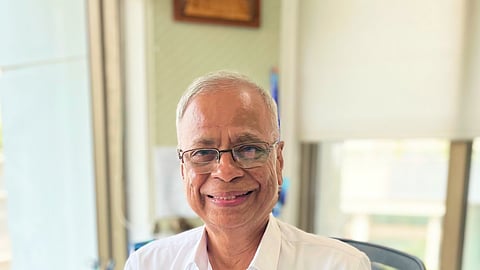

There was a time when the biggest hurdle to getting a telephone in India wasn’t the cost — it was the wait. Prof Ashok Jhunjhunwala didn’t. That instinct to take on what others call impossible has defined a career that includes building IITM Research Park, India’s first deep-tech incubation model, and now continues as chairman of the governing council at IIIT Hyderabad. His biography, Roots & Wings, authored by Saloni Malhotra, traces his journey from researcher to mentor, entrepreneur, and institution builder. He had helped shape India’s telecom and innovation ecosystem by developing affordable technologies in telecom, internet connectivity, banking, renewable energy, and electric mobility while nurturing generations of entrepreneurs and researchers. In this conversation with CE, he reflects on the failures behind the milestones, the realities young entrepreneurs often overlook, and why India must build its own technology rather than depend on others.
Excerpts
What convinced you that this was the right time to tell your story through Roots & Wings?
The initiative wasn’t mine, but Saloni’s. She approached me saying she wanted to write the book, and I couldn’t say no. Around the same time, I had handed over charge of IITM Research Park after building it over 18 years, so it felt like one chapter had ended.
India is also at a stage where incubation is well established, and deep-tech incubation is recognised as the way forward. Since we created the first deep-tech incubation system, I felt it was important to tell that story.
More importantly, I began my journey trying to solve India’s problems. While we achieved a great deal, those problems remain acute. They cannot be solved by simply buying technology from abroad. We need to develop our own technology. If this story inspires people to do that, nothing could be better.
Recent global developments have also reinforced that we cannot depend on other countries for critical technologies. A nation of 1.5 billion people has to stand on its own feet. That, along with Saloni’s persistence, made this the right time.
The book traces your journey from researcher to mentor, entrepreneur and institution builder. Which role taught you the most?
I returned to India with one purpose: to help change the country. Whether it was tackling the telephone waiting list or making technology affordable, I was trying to solve problems.
To do that, I relied on two strengths. One is India’s 150,000 R&D scientists. They publish excellent research, but many don’t translate it into technology. The second is young engineering students and graduates whom I’ve taught from the beginning.
So I can’t separate these roles. Researchers, startups and institutions all have to work together. IITM Research Park happened because it was needed to achieve that goal. I never set out thinking I wanted to become an institution builder.
Looking back, what were the biggest challenges people rarely saw?
When you choose difficult problems, obstacles come immediately. The first challenge is finding people who believe an impossible task is worth pursuing and keeping them together through years without immediate success.
Then comes the technology itself. You constantly ask whether something is possible and whether it can also be made affordable.
Even after solving those issues, change management becomes the hardest challenge. When we introduced wireless technology, many bureaucrats opposed the idea of towers across cities because they feared change. But without change, new technology cannot emerge. There is also resistance from competitors, especially multinational companies that don’t want inexpensive Indian technologies disrupting their business.
Over time, I realised obstacles are part of life. Overcoming them brings immense satisfaction and inner strength.
I’ve also found that when you work on meaningful challenges, unexpected people come forward to help. That has happened repeatedly throughout my journey.
You’ve worked on telecom, banking, mobility and connectivity. How have you identified important problems before others?
I don’t think I identify problems earlier than others. Most problems are obvious. An eight-year waiting list for telephones was obvious. Expensive ATMs were an obvious problem. Traffic congestion today is obvious.
What happens is that people eventually believe such problems have no solution because nobody has solved them before.
I’m attracted to problems that appear impossible because that is where the greatest challenge lies. I simply refuse to accept failure. There are many failures along the way, and they can be devastating, but you have to get up and start again.
You’ve often spoken about technology serving society. Is today’s innovation ecosystem connected enough to real-world needs?
Consider telephones. Earlier, very few people had access; today almost everyone carries a mobile phone. Of course, mobile technology has created problems too, from excessive screen time to misinformation. Every technology has negative aspects.
But overall, society has progressed because people are connected.
If we solve traffic congestion through technology, that is progress too. We are also working on technologies to eliminate urban waterlogging during heavy rains. Rainfall may remain unpredictable, but cities need not flood. That, to me, is positive use of technology.
Having mentored hundreds of startups, what misconceptions do young founders have?
Many young people are attracted by the glamour of startups. They hear stories of billion-rupee companies and overnight success, but entrepreneurship is probably the hardest career path.
You work 16–18 hours a day, six-and-a-half days a week, often for years without meaningful income. In a regular job, you begin earning from day one.
Failure is also almost certain. What matters is whether you can get up and begin again.
When students approach us wanting to start companies, our first responsibility is to show them the reality. If they still want to become entrepreneurs, we support them fully.
We also ask whether their family depends on them for immediate income. If the answer is yes, they should probably take up a job first because startups rarely provide financial stability in the early years.
What concerns you most about India’s current startup narrative?
The biggest concern is the glamour surrounding entrepreneurship because it creates unrealistic expectations.
Another concern is easy money. Governments and incubators sometimes provide grants too quickly. I believe easy money can hurt a startup. Founders should earn every rupee through hard work. Living hand-to-mouth in the early years teaches discipline and resilience.
How can founders stay focused on impact despite pressure to chase growth and visibility?
The pressure changes once funding comes in. Before that, it is your own determination driving you. Afterwards, investors also expect returns.
That is why I believe incubators should avoid making things too easy. Startups should grow one step at a time.
I compare it to a child learning to walk. The child falls repeatedly, but every fall teaches balance. Parents should prevent serious injury, not prevent every fall.
A startup is exactly the same. If you remove every difficulty, it never learns. An incubator should encourage founders, celebrate every small step, and ensure they don’t get badly hurt — but it cannot replace the struggle. Hard work and learning from failure are what ultimately make entrepreneurs independent and successful.
