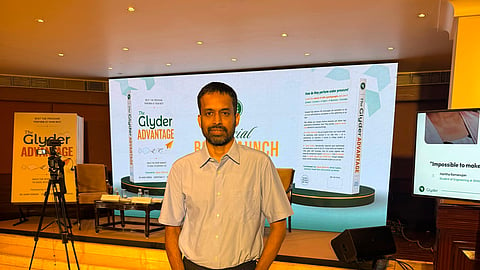

Sports has never been just about medals and trophies, but also learning about how to deal with pressure, staying patient, and finding strength to keep moving forward. Those ideas formed the core of The Glyder Advantage, a book recently launched at Taj Krishna, Banjara Hills. Former All England champion, Padma Shri awardee and chief national coach of the Indian national badminton team, Pullela Gopichand, spoke to CE at the book launch about why the lessons learnt on the court can be just as valuable in everyday life.
For the Padma Bhushan recipient, one of the biggest strengths of the book, authored by Gopinathan CP and Ritu Vinayak, is that it takes lessons from sports and makes them relatable for everyone, not just athletes. “I think it’s a great book because it makes the learnings of sports available for everyday people, which is wonderful. When you talk about growth mindset, goal setting and performing under pressure, these are very apt for sports because the outcomes are measurable. The pressure of performance is very real and high in sports. Gopinathan CP garu and Ritu Vinayak have presented these ideas in a way that is readable and usable,” he says.
Speaking about what helped him stay steady during both success and failures, he shares, “The love for the sport, wanting to be better and better, while enjoying the process, is what I really love.”
After spending decades coaching athletes, he feels many young people today are too focused on the finish line instead of the journey that gets them there. “Doing justice to your talent is important. Success is a journey and a mindset. It’s not a goal. The goal is the process and the mindset of continuous improvement. Wherever you are, if you’ve fallen, start again, motivate yourself, understand what needs to be done, and do it,” explains the Arjuna awardee.
He also believes that when progress seems invisible, the most important thing is to first accept reality and then take one step at a time. “Getting back to reality is very important. You’re injured, you’re out of the team, and this is reality. I might have been a great player earlier, but this is what I am. The next step is understanding how to move forward, whether it is starting to walk, run and sprint after an injury, or getting back into the team. The book talks about setting goals, breaking them into simple processes, and then starting to work on them,” he highlights.
Looking back at his own career, Gopichand says his definition of success has become much simpler. “Give it the best shot, stay positive and be responsible for where you are always,” he notes.
In a world driven by instant gratification and constant comparison, he feels patience has become more important than ever. He states, “It is extremely important because our attention spans are getting smaller and mindsets are becoming oriented towards short-term goals. It is important to be process-driven with a long-term vision, while avoiding getting influenced by others.”
Years of working with athletes under pressure have also taught him about how confidence cannot always be judged by appearances. “Not all of what you can articulate is the way things are. Somebody might be supremely strong inside, but what has happened in society today is that people are very good at talking, not necessarily very good when the pressure situation arises. Maybe somebody is really good in the pressure situation but is not able to talk very well, and these two need to be distinguished. Somebody coming from a village may be raw, yet under pressure he doesn’t crack, while somebody articulate may always trip and cry,” he expresses.
Asked what helps athletes become mentally stronger, he pointed towards stepping outside their comfort zone. “To challenge themselves, break new barriers, challenge their fears and overcome what is uncomfortable because I think these are important,” he notes.
For people who keep waiting for the perfect time to begin, Gopichand believes the biggest breakthrough comes from simply taking the first step. “It’s very important that we don’t know what’s going to come up, so we need to jump because if you want safety, you’re not going anywhere. Things change when you plunge and dive into them. People are still very scared of taking the first step because they overthink the consequences that might or might not occur. Growth is not in safety, but in being in uncomfortable and unknown situations because that will actually help you,” he concludes.
Listening to Gopichand, one thing becomes clear: the lessons that shape champions are not limited to sport. They are about showing up every day, embracing uncertainty and trusting the process, whether you are chasing a medal or simply trying to become a better version of yourself.
