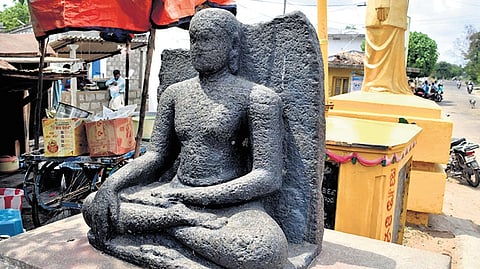

HYDERABAD: History has a habit of hiding in plain sight. It has appeared as a roadside bench in Guntur, a temple step in a village shrine, a carved stone in a farmer’s field and even during an unplanned tea break in Eluru. Each revealed another forgotten chapter of India’s past.
For archaeologist Dr E Sivanagi Reddy, they are a reminder that archaeology is rarely about planned excavations alone. Many significant finds begin during routine field visits, conversations with villagers or chance encounters. Through the PLEACH India Foundation’s Preserve Heritage for Posterity (PHP) programme, researchers have documented heritage across more than 1,800 villages in Telangana and Andhra Pradesh, recording thousands of neglected monuments, sculptures, inscriptions and archaeological remains.
One such moment came during a roadside tea break. While waiting, Dr Reddy noticed a carved stone pillar being used as part of a roadside structure. A closer look revealed it to be an early medieval Buddhist pillar from Pinakadimi in Eluru, dating back nearly 1,500 years. Rather than merely documenting it, he persuaded the landowner and villagers to preserve it. Today, the pillar stands on a raised platform as part of the village’s heritage.
It was not an isolated incident. In Vaikuntapuram village in Guntur district, a Buddha bhumisparsha mudra sculpture had spent years serving as a bench outside a shop. Archaeologists identified it as a ninth-century sculpture and, with the support of villagers, relocated it to a pedestal for preservation. “People are not at fault,” the archaeologist tells TNIE. “Most of them simply do not know what they have.”
For the archaeologist, that is where heritage conservation truly begins. Rather than criticising communities for unknowingly using sculptures as building material or inscriptions as doorsteps, PLEACH explains the history and significance of each artefact, encouraging villagers to become custodians of their heritage.
According to him, this approach has prompted many villages to voluntarily protect sculptures, build platforms for them and alert archaeologists whenever something new is found.
The same approach has taken researchers into remote villages, forests and rocky hilltops, where local folklore often provides the first clue. In one village, residents spoke of a stone that changed colour every evening. Waiting until sunset, Dr Reddy found the effect was caused by sunlight interacting with the stone’s mineral composition, showing how traditional beliefs can sometimes have scientific explanations.
Some of PLEACH’s most significant discoveries have come from equally ordinary moments. A carved stone spotted in a farmer’s field turned out to be a medieval Durga panel, while a 1518 CE inscription of Sri Krishnadevaraya was found embedded in the steps of a village temple, where devotees had unknowingly walked over it for decades before it was documented and preserved.
Not every monument can be saved. The archaeologist recalls temple remains lost to road widening and sculptures displaced by construction. “Documentation itself is preservation. Even if a monument disappears tomorrow, its history survives,” he says.
For PLEACH, the mission goes beyond documentation to helping people recognise the history around them. “Thousands of people may walk past an ancient sculpture without noticing it,” he says. “All it takes is one observant person to save it.”
