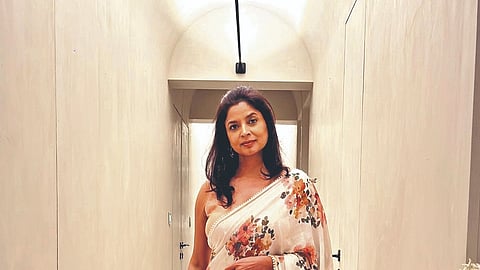

Creativity deserves recognition, and sometimes the boldest ideas become the most celebrated. With the announcement of 72nd National Film Awards, Pushpa 2: The Rule earned widespread acclaim, including the National Award for Best Costume Design. The honour went to costume designer Deepali Noor, whose work played a crucial role in shaping its gritty, larger-than-life world and the evolution of its unforgettable characters. CE caught up with National Award-winning costume designer Deepali Noor, who reflected on the honour, the extensive research behind the costumes, the collaborative process with director Sukumar, and what it took to create the visual identity of Pushpa.
Excerpts
How does it feel to receive the National Award?
It is one of the most humbling moments of my life. A lot of hearts and minds came together for this project. This is not just a personal achievement, but a recognition of the collective effort and vision behind Pushpa. I feel incredibly grateful to the director, producers, actors and everyone who worked tirelessly behind the scenes. This award belongs to the entire team. I have been associated with Pushpa right from its conceptualisation. From the very beginning, we understood that Pushpa was an ordinary man whose journey would transform him over time. For us, costume design is never about simply dressing an actor. It begins with understanding the character. We research everything — the climate, culture, occupation, fabrics available in that region, the time period and the social setting. Every detail influences what the character wears. All of that research eventually finds its way into the costume, making it an extension of the person rather than just clothing.
What were the biggest challenges while designing the costumes?
We shot in extremely challenging terrains, and every film I work on follows the same philosophy — I want audiences to notice the character before they notice the clothes. The costumes should become a part of the actor’s personality. To achieve that, we did extensive fabric dyeing, texturing and ageing. The clothes had to look naturally worn, never perfect. Even the way a lungi was draped or how a pair of trousers fit contributed to Pushpa’s personality. As he evolves, his costumes become flashier, but they still remain rooted in his character. I designed costumes for every single member of the cast. Each character had multiple versions depending on action sequences, weather conditions and continuity. Managing thousands of costumes while maintaining the same colour palette and visual consistency across such a large-scale production required immense planning and teamwork.
Did any last-minute changes happen with the costumes?
Absolutely. It is always a pleasure working with director Sukumar. This is my third film with him, and he is incredibly creative. We always prepare according to the script, but filmmaking is a dynamic process. Sometimes locations change, new scenes are added or actors want to experiment with something different. As a costume designer, flexibility is one of our greatest strengths. Instead of treating changes as obstacles, we see them as opportunities to improve what we have already envisioned. Some of the best design ideas actually emerge spontaneously during the filmmaking process. A film evolves continuously from the day it begins until the final day of shooting, and costume design evolves along with it.
What was the most enjoyable part of the design process?
I have never been someone who walks into a mall and simply picks something off the rack. I have always loved creating something new and experimenting with unconventional ideas. The best part was sitting with my team, brainstorming endlessly and exploring different possibilities for every character. Watching those ideas come together was incredibly satisfying. The Pushpa team became like family. We spent nearly five years together across Pushpa and Pushpa 2, and those memories will always stay with me.

Were there ever disagreements between you and director Sukumar?
I wouldn’t call them disagreements, I would call them creative discussions. Creative conversations are a natural part of filmmaking. Whether it is between the costume designer, cinematographer, production designer or director, everyone brings their own perspective while striving for the same goal. We would often discuss whether a different colour or look would better serve the character or the story. These conversations were always healthy because they were never about individual preferences, they were about finding what worked best for the film. Sukumar has an exceptionally clear vision. He knows exactly what he wants, and his understanding of emotion is remarkable. My role was to contribute creatively while enhancing his vision, and that made the collaboration extremely fulfilling.
Whose costume was the most difficult to design?
Rather than a single costume, I would say Pushpa’s overall journey was the most challenging. The film features a huge ensemble cast, and every character had to look distinct while still belonging to the same world. Designing that gradual transformation, ensuring every character had a unique identity and making sure no two people looked alike was a massive challenge.
What does design mean to you?
Design is the expression of an idea, a thought and a personality. The way someone dresses often tells you who they are, what they believe in and how they see the world. A costume is not just fabric, it communicates character. For me, design is identity. It is a person’s definition.
What projects are you working on next?
I am currently working on Dragon, directed by Prashanth Neel, starring Jr NTR, Anil Kapoor and Ashutosh Rana. I am also working on Jai Hanuman, directed by Prasanth Varma, starring Rishab Shetty, Akshaye Khanna and Rana Daggubati. Both projects are currently in progress.