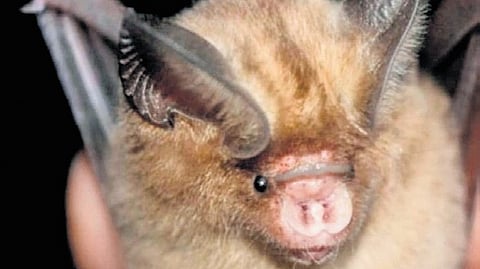

HYDERABAD: A study by researchers from Osmania University has found that insect-eating bats, including the critically endangered Kolar roundleaf bat, play a crucial role in protecting agriculture and public health by feeding on thousands of insect species, many of them crop pests and disease vectors.
Published recently in the Journal of Threatened Taxa, the study analysed four leaf-nosed bat species inhabiting a cave at Hanumanahalli in Karnataka’s Kolar district, the only known habitat of the Kolar roundleaf bat (Hipposideros hypophyllus), whose global population is estimated at fewer than 300.
Using DNA metabarcoding to analyse bat guano, researchers found that the bat alone feeds on over 4,100 insect species, while the other three species consume between 1,200 and 2,400 species. Nearly 40% of the bats’ combined diet comprised insects harmful to agriculture, livestock or human health, including mosquitoes that spread dengue and malaria, crop-damaging moths and disease-carrying cockroaches. It found that the four bat species occupying the same cave feed on different groups, a phenomenon known as resource partitioning that reduces competition while expanding natural pest control.
The researchers said this is the first study in India and South Asia to use DNA metabarcoding to analyse bat diets. Prof Chelmala Srinivasulu, head of the Wildlife Biology and Taxonomy Lab at OU, said the findings challenge misconceptions about bats. “They provide clinching evidence that these animals perform invaluable ecosystem services by naturally controlling agricultural pests and disease-carrying insects,” he told TNIE.
Co-author Dr Aditya Srinivasulu said understanding bat diets is vital for conservation planning. The team plans to extend the research to other bat families to understand their role in pest control and biodiversity conservation, he added.
