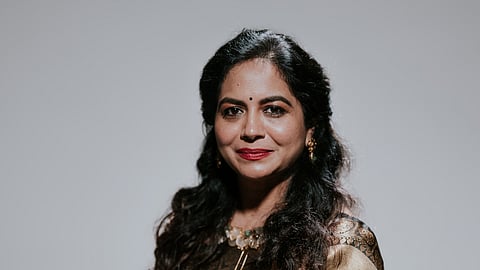

Ask music lovers about their favourite Sunitha Upadrashta song, and chances are each answer will come with a memory attached to it. Such is the impact of a voice that has transcended generations and genres, becoming synonymous with emotion and authenticity. As she gears up for Timeless at Shilpakala Vedika on June 13, a celebration of songs that continue to live in the hearts of listeners, she interacts with CE about the melodies that shaped her journey, the evolution of music over the years, and the stories hidden behind some of her most memorable recordings.
Excerpts
What do you think gives a song the power to remain timeless across generations?
A haunting melody tuned with simple yet meaningful lyrics. When you read or discuss a song, the depth of its lyrics should connect you to an instance from your own life.
Which version of Sunitha feels most authentic to you on stage today?
Honestly speaking, melody is my forte. While music, society, and even I have changed over the years, whenever I get a chance to sing a beautiful melody, I feel blissful. I also enjoy peppy numbers because people once felt my voice only suited melodies. But composers like MM Keeravani and Mani Sharma gave me opportunities to challenge that perception. Songs like Aagipothe Thappu, Avunu Nijam, and You Are My Treasure are melodious yet energetic. They pushed me to sing differently, and that was always fun. In any way, singing is fun.
What kind of atmosphere are you hoping to create with Timeless?
Timeless is very precious to me. About 30 years ago, I sang a track for a Doordarshan serial that people would wait to hear every day at 4 pm. My mother used to tell me how she listened to that song on her walk to school and would say every day, ‘What a beautiful song’. Even today, when I think about those days, I smile. That is nostalgia for me. I’m sure people coming to the event will connect to films like Mayabazar, Malliswari, Badri, Godavari, and even songs like Suvvi Suvvi Suvvalamma from Swati Mutyam. Every song has been handpicked and theme-based, and each one will take audiences down memory lane.
What excites you most about the current generation of musicians?
No boundaries. No fear. The sky is the limit. Today’s composers create hundreds of tracks for a single song. Layers, harmonies, and arrangements have no limits. I’m amazed by what they create. I’m equally fascinated by how singers are evolving. I learned Carnatic, light, and devotional music, and I still feel nervous attempting an English track. But this generation sings English, Korean, and so much more with confidence. They are fearless.
Which songs have always stayed special to you?
Not my first song, but my second song, Maagha Maasam from Egire Pavurama. After several auditions, my voice was selected. Before the recording, I was told about all the singers who had attempted it before me. For a moment, I was terrified. I wondered how I could prove myself after such big names. Eventually, I told myself that even if my voice was rejected, I would wait for another opportunity. I sang, and they finalised my voice. I still remember that tense moment, and that makes the song very special. Every song has a story. I sang Andangalena from Godavari with a temperature of 102 degrees. I was on my way to the airport when Keeravani called and asked where I was. I postponed my flight, went to the recording theatre, recorded the song, and then headed straight to the airport with my luggage. That’s why every song means something beyond the recording itself.
Do you approach singing more like storytelling than performance?
It is storytelling. Cinema itself is storytelling. When you sing a film song, you are singing for a particular scene and character. You are not singing as yourself. You have to feel that character and create the emotion, drama, and mood required for the scene.
Is there a genre audiences haven’t fully seen from you yet?
Naughty and peppy numbers.
What gives you butterflies before stepping onto a stage?
The audience. I may have performed hundreds or even thousands of shows, but I never sing my first song perfectly. It takes me time to settle down. Whenever I see the audience, I feel as though I’m facing them for the first time. It has nothing to do with experience. Maybe it has become a sentimental thing for me. If I feel those butterflies during the first song, I somehow believe the show is going to go really well.
