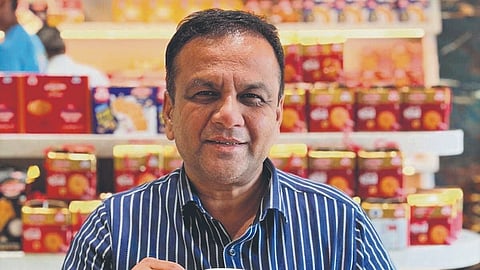

As Muharram approaches, Hyderabad’s iconic Dum Ka Roat once again finds its place in homes across the city and beyond. This rich, aromatic baked delicacy has long been associated with the sacred month, drawing devotees and food lovers alike. Among the many bakeries that prepare it, Subhan Bakery remains the most renowned, having played a pioneering role in bringing Dum Ka Roat into the commercial market. Speaking about the delicacy’s history and evolution, Syed Irfan, owner of Subhan Bakery, shares insights into its enduring popularity.
Explaining the origins of Dum Ka Roat and its connection with Muharram, Irfan says, “It is an age-old tradition. Initially, it was prepared on a roti tawa, but later we began baking it in ovens. The dough would be mixed, shaped into pedas and then baked. In the 1970s, it became commercial. We were among the first bakers to introduce it on a larger scale so that people could not only enjoy it themselves but also share it with others.”
Talking about its significance during Muharram, he explains, “In India, there is a tradition of offering sweets as a mark of devotion. People would offer Dum Ka Roat at Bibi Ka Alam during Muharram. Over time, that practice gradually changed, and instead of offering it at the Alam, people began distributing it among relatives, friends and neighbours.”

The preparation of Dum Ka Roat has always intrigued many. Describing the ingredients that go into making it, Irfan says, “Dum Ka Roat is prepared using semolina, rawa, pure ghee, khoya, sugar, dry fruits, saffron and fennel seeds, which gives it distinctive rich flavour. Earlier, we used vanaspati to make it, but for the past 25 years we have been using pure ghee.”
When asked about variations of the delicacy, Irfan is quick to point out its originality. “There are no variations as such. What you find elsewhere is often inspired by the Subhan Bakery version. For us, that is a matter of pride because it means we have set a benchmark,” he notes.
What was once a seasonal offering is now available throughout the year. “For many years, we prepared Dum Ka Roat only during the Muharram season, roughly for a month. However, about five years ago, we started making it throughout the year because the demand had become so strong. Customers kept asking why it wasn’t available every day, so we decided to make it a regular product,” he explains.
The recipe itself has evolved over the decades to suit changing tastes. “Today, people prefer higher-quality ingredients, so we switched to pure ghee and premium dry fruits. Customers now expect almonds, cashews and pistachios, which has naturally influenced the recipe,” he says.
Demand for Dum Ka Roat has expanded far beyond Hyderabad. According to Irfan, the bakery regularly ships the delicacy to several countries. “We supply Dum Ka Roat to Dubai, Canada, the United States and various Gulf countries. Due to the ongoing geopolitical situation, there have been some challenges in shipping to certain Gulf regions, but the demand remains strong. Dum Ka Roat has evolved significantly over the last 50 years. Had we not adapted to changing times and preferences, it might have become outdated,” he clarifies.
Reflecting on his family’s contribution to preserving and popularising the delicacy, Irfan says, “My father, Syed Subhan, was the first to commercialise Dum Ka Roat. Later, I refined and reinvented the recipe while continuing to uphold the tradition through our bakery.”
A symbol of faith, sharing and culinary heritage, Dum Ka Roat continues to be an integral part of Muharram observances while winning new admirers with every passing generation.