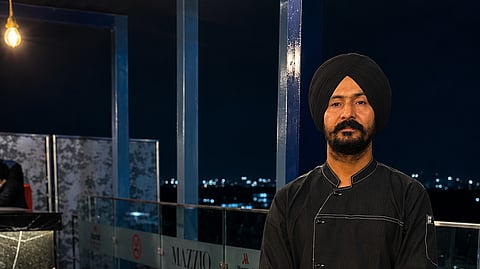

Food in Punjab is as much about hospitality as it is about flavour, and nowhere is that spirit more evident than at the Amritsari Food Pop-Up at Mazzo, Marriott Executive Apartments Hyderabad. Curated by Chef Nachhater Singh, a proud son of Amritsar, the festival presented an authentic taste of the region through dishes that are comforting, robust and deeply rooted in tradition.
“I belong to Amritsar, and everything that I’ve brought here is authentic Amritsari cuisine. Be it the fish, Amritsari Chole-Kulche, Chicken Amritsari or the curries, these are flavours I grew up with,” began Chef Nachhater.
The meal begins with a comforting bowl of Paya Ka Shorba, rich yet delicate, carrying the deep flavours extracted from slow-cooked trotters. Among the standout appetisers is the Amritsari Fish, a dish synonymous with the city itself. Lightly battered and fried to a golden crisp, the fish boasts a perfectly spiced coating while remaining tender and flaky within. Equally impressive is the Lasooni Prawn, where garlic takes centre stage, lending bold flavours to succulent prawns.

The tandoor selection shines with dishes such as the Malai Chicken Tikka, creamy and melt-in-the-mouth, and the Angara Murgh Tikka, carrying a smoky depth that lingers pleasantly. Vegetarians are equally well looked after with the Ajwani Paneer Tikka, where the subtle fragrance of carom seeds elevates soft paneer, and the ever-popular Hara Bhara Kabab, crisp outside and delicately spiced within.
For him, authenticity lies not in complexity but in restraint. “I always believe that the taste should come from the hands of the cook. For these home-style dishes, we don’t use ready-made masalas. We rely on fresh onions, tomatoes, cumin, coriander powder and turmeric. The pride of Punjabi food is desi ghee, mustard oil and white butter,” he noted.
The main course reflects this philosophy beautifully. The Amritsari Chole arrives robust and earthy, cooked with measured spices that allow the chickpeas to retain their character. Paired with the comforting Aloo Wadi Amritsari, the meal evokes the simplicity of a Punjabi household lunch.
The Punjabi Kadhi Pakoda deserves special mention. Silky, tangy and comforting, it carries the kind of warmth that only slow-simmered yoghurt-based gravies can deliver. Alongside it, the Rajma Rasila is hearty and soulful, with kidney beans cooked until they absorb every layer of flavour.
Vegetable preparations such as Paneer Makhan Wala, Masala Baingan, and Bhindi Do Pyaza showcase the versatility of Punjabi cuisine beyond its celebrated meat dishes. The non-vegetarian curries are perhaps the festival’s biggest revelation. The Dhaba-style Mutton Curry is robust and deeply satisfying, while the Lahori Chicken impresses with its surprisingly restrained spice profile.
Accompaniments such as steamed rice and the fragrant Wadi Pulao provide the perfect canvas for the rich gravies, allowing the flavours to take centre stage.
No Punjabi feast is complete without a memorable dessert, and the festival concludes on a nostalgic note with Ganne Ke Ras Ki Kheer. Prepared using sugarcane juice instead of refined sugar, the dessert offers a distinct sweetness and depth that sets it apart from conventional kheer.
“This kheer is traditionally prepared during Lohri. It is made on the festival day and enjoyed the next day with family. It’s a dish filled with memories for us,” he highlighted.
Beyond the food, what resonates most throughout the experience is the spirit of Punjabi hospitality. Every dish feels personal, carrying stories of family kitchens, festive celebrations and generations-old recipes.