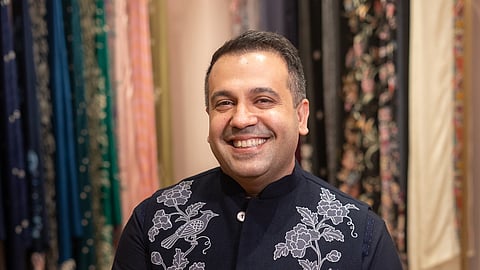

At a time when heritage references are often aestheticised without technical depth, She Walks in Beauty, Spring–Summer 2026 collection by textile designer and researcher Ashdeen Lilaowala positions archival research as the foundation of design practice. The archive-inspired sarees feature traditional Parsi Gara motifs such as cranes, chrysanthemums, lotuses, peonies and other flora and fauna. The karolia or spider motif — resembling a pinwheel and believed to symbolise protection — warrants special mention. The collection was showcased at the ASHDEEN atelier in Anahita, Banjara Hills, during a two-day special pop-up. CE speaks to Ashdeen about the collection, Hyderabad as a market, and his journey with the craft.
Excerpts
Tell us about She Walks in Beauty.
She Walks in Beauty is our latest line of classical sarees inspired by my extensive Parsi Gara archive, which I began collecting even before launching my label in 2012. The colour palette features classics like ruby red, opal green, alphonso, emerald green, wine, carnation, royal blue and violet, realised in easy-to-move fabrics with a subtle sheen such as crepe, crepe jacquards and satin. We launched the collection at Anahita in Hyderabad.

How do you see Hyderabad as a market for your label?
Hyderabad is one of our favourite cities in the country. I admire the self-assured sense of style the women of Hyderabad have — it’s informed by heritage but interpreted with contemporary ease. The women here are discerning and have a strong interest in textiles, which makes it rewarding for a slow-fashion brand like ours to resonate with customers in the city.
What first drew you towards textile design and fashion?
As a child, I encountered resplendent Parsi Garas covered in intricate hand embroidery. I watched as the women in my family treasured them, taking them out of the armoire only for special occasions. Being raised by a mother with an incredible sense of style, and growing up with two sisters in a Parsi baug in Mumbai on a steady diet of cinema, music, theatre and textiles, further strengthened this bond for me.
What inspired your focus on reviving and reinterpreting Parsi Gara embroidery?
By the time we created our third or fourth collection, I realised that through this work I was representing my community. It became important to do justice to this craft while engaging with newer audiences. To me, the Gara is not just beautiful — it is a living tradition I have dedicated my life to stewarding. Today, I see myself as a contemporary keeper of stories, not just of the Gara but of the larger Parsi culture as well.
Can you walk us through the process of creating a Gara piece?
The process begins with ideation and identifying a theme. From there, we develop a mood board, colour palette and embroidery designs. We then sample the embroideries, finalise the textiles and move into production. Alongside this, we also work on bringing the story alive through a campaign.
How do you ensure traditional craftsmanship remains relevant to younger audiences?
Our endeavour at Ashdeen has been to preserve the essence of Parsi Gara embroidery while innovating in form. This has helped us engage both younger Parsis and non-Parsi wearers. It translates into stylised applications of motifs, a colour palette adapted to modern tastes and lighter, more wearable fabrics. We have also expanded embroidery applications onto lehengas, blouses, jackets, scarves and accessories to enhance wearability.
What role do artisans play in your creative journey?
Our artisans are at the heart of everything we do. One of our missions has been to create sustained livelihoods for them. We work with over 300 artisans across West Bengal, Uttar Pradesh and Delhi. Over the years, these relationships have evolved into exchanges of ideas rather than simple instruction. Some master craftspeople have even become entrepreneurs running their own studios, and we have been able to involve families and younger generations in the craft.
What inspires your motifs, colour palettes and storytelling?
Research and archives play a big role, along with travel, other handcrafted traditions like ceramics and fine art, and of course Parsi heritage. My research has taught me that motifs often travel across cultures, transforming into distinct patterns and acquiring new identities. Discovering these journeys is always thrilling.
How do you see textile design evolving in India today?
As the world becomes increasingly automated and globalised, people are seeking handmade crafts — stories they can connect with and art forms they can feel. At this moment of change, I remain hopeful about the future of Indian textiles and niche art forms like the Gara.