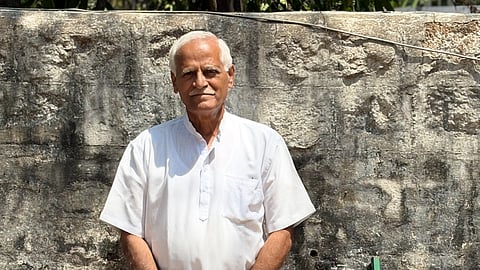

In the quiet villages of Andhra Pradesh and Telangana, a silent revolution is underway — one that doesn’t depend on skyscrapers, high-tech labs, or glossy boardrooms. Here, innovation wears a humble face: a farmer tinkering with a sprayer, a schoolgirl inventing a device to ease her mother’s chores, a local artisan refining centuries-old techniques. Palle Srujana is the invisible hand behind this grassroots brilliance, scouting the rich tapestry of rural creativity, documenting it, and transforming it into solutions that seamlessly blend tradition with modern impact. Operating purely on volunteerism, the organisation turns villages into living laboratories, where knowledge flows horizontally — from land to land, village to village — empowering communities, preserving heritage, and proving that true innovation doesn’t always come from the city; sometimes, it comes from the heart of the countryside. CE interacts with Brigadier P Ganesham (VSM), a retired Indian Army officer and founder of Palle Srujana, a voluntary organisation established in 2005, about mentoring, and promoting rural grassroots innovations in Andhra Pradesh and Telangana. Based in Secunderabad, he has helped over 200 rural innovators secure patents, recognition, and commercial success, including recipients of the Padma Shri award.
Excerpts
As a Brigadier, you led people in the army. What inspired you to transition from military leadership to nurturing grassroots innovations through Palle Srujana?
In the army, we frequently face crises and complex situations imposed by nature — conditions over which we have little control. Yet, the mission must always be accomplished. Across diverse terrains, from Siachen to Gujarat and the eastern regions, we learned that the environment plays a decisive role. And who confronts this environment directly? It is the soldier on the ground, weapon in hand — not the general operating from behind the lines.
The responsibility to adapt, therefore, rests with the soldier. To succeed, he must innovate. Often, this innovation is not even conscious; it emerges from necessity. He modifies, adjusts, and rethinks so that his equipment functions effectively and the mission is achieved. Without such innovation, success would be impossible. Over time, we
realised that victory in battles and wars is not determined solely by planning, weapons, or advanced technology. It is the innovation of the individual on the ground that truly makes the difference. Generals may plan wars, but soldiers win them and not just through courage or patriotism, but through ingenuity.
This realisation became especially clear during the Kargil War. I understood then that such grassroots innovation needed to be documented. Once documented, it could be shared. We would no longer need to wait for crises to trigger innovation — ideas could continuously evolve and spread. As a result, we initiated a large-scale effort at headquarters to capture and disseminate these innovations. Innovation cells were established to tap into the creativity of personnel at the lowest ranks. This effort proved immensely beneficial. As ideas spread, horizons broadened—what one individual developed could be learned and adapted by many others.
I became convinced that immense creativity exists at the bottom of every organisation. In many ways, those at the lowest levels often hold the most practical knowledge. This led me to question whether the same principle applied beyond the army — in government institutions, in society, and in private industry. I was uncertain, as the army operates within a highly structured, vertical system.
During this period, we developed a unique vehicle called ‘Windy’ — something that did not exist anywhere in the world but was required by the army. To create it, we brought together 30 to 40 grassroots innovators — jawans whose ideas we had collected over time. I invited them to Delhi and asked a simple question: ‘Can you build this?’ With access to facilities and support, they succeeded within an unexpected time. The result was a multi-weapon platform that performed exceptionally well across terrains.
However, we faced a new challenge: what to do with it? The army is not a manufacturing or R&D organisation. So, we decided to showcase it outside South Block. The response was overwhelmingly positive. A week later, the defence minister visited. After a 20-minute briefing, he expressed astonishment that such an innovation had been created within the Indian Army.
The vehicle went on to participate in the Republic Day Parade in 2005. It became the Indian Army’s first patented invention since independence, and a moment of great pride and recognition.
That same evening, Anand Mahindra reached out to me, curious about how such an achievement was possible when even large industrial groups had struggled to deliver similar innovations for the army. This interaction led me to the National Innovation Foundation (NIF), where I witnessed efforts to identify and support grassroots innovators across the country — individuals creating small yet impactful solutions in their communities.
At that point, my hypothesis was confirmed: the power of bottom-level innovation extends far beyond the army — it is a universal phenomenon.
I retired in October 2005, and within weeks, I decided to dedicate myself fully to this cause. I made three important decisions:
First: I chose not to earn any income beyond my pension. This gave me complete freedom to work selflessly and dedicate all my time to others. It brought a deep sense of peace and fulfillment.
Second: I decided to make myself ‘zero’ at the age of 60 — to begin learning anew. By walking through villages, observing closely, and unlearning past assumptions, I gained insights far richer than anything I had learned in my earlier years.
Third: I chose to start a voluntary organisation with no funds, no employees, no defined mission, and no rigid objectives. This was the beginning of Palle Srujana. Over the past 20 years, it has grown organically — without targets, without fear of failure — guided only by continuous learning and evolution. People joined gradually, one by one, forming a community driven by shared purpose.
This journey reaffirmed a simple but powerful truth: innovation does not belong to institutions or hierarchies; it belongs to people.
How did your experience in the armed forces shape your approach to rural innovation and community development?
This is not ‘community development’ in the conventional sense. The knowledge we need already exists — we simply have to uncover it. The real task lies in identifying that knowledge, documenting it with the permission of its owner, and then ensuring its horizontal dissemination: from land to land, farmer to farmer, and village to village.
When people within the same environment communicate with each other, understanding happens more naturally and quickly. They share the same language, context, and challenges — their pain is mutual. This makes their exchange far more effective than any external intervention. Grassroots innovations can best be described as ‘painkillers’. Wherever there is a problem or hardship, innovation emerges organically to address it. These solutions are often highly effective, resolving 80 to 100 percent of the issue. More importantly, each innovation has the potential to benefit many others facing similar challenges. Such innovations are deeply rooted in local contexts — they draw upon local problems, utilise local resources, involve local manufacturers, and serve local consumers. This creates a self-sustaining, localised economic model where wealth circulates within the community. In this approach, development is not the primary objective; rather, it becomes a natural byproduct of the process. At its core, knowledge is transformative. It fosters not only economic growth, but also happiness, peace, and well-being. By relying on local resources and wisdom, communities can achieve sustainability while maintaining a balanced and fulfilling way of life.
When Palle Srujana began, what were the biggest challenges in convincing people that grassroots knowledge deserves recognition?
Nobody believed that villagers could innovate. We walked in with the conviction that knowledge exists, and it did not disappoint us. The question was, whom do we convince first: the formal system, bureaucrats, politicians, or investors? We chose to focus on horizontal sharing. One village with a solution could help another village facing the same problem. We walked, demonstrated, and always took permission from the innovator. Gradually, people began to improve the solutions. Innovations could be modified, adopted, and sold. Trust was difficult to build, but support from the system was essential for scaling.
How did you start collecting and sharing these innovations?
We reported the innovations to the National Innovation Foundation (NIF), then decided to share them because knowledge should be accessible. Later, we started Palle Srujana magazine. I had no journalistic experience, but the need was strong. The magazine focused only on village knowledge made by villagers, for villagers, in Telugu. Volunteers handle everything. We also had actress and model Manasa Varanasi supporting us with the works. We also started Chinna Shodha Yatra — a three-day village walk every six months. Participants unlearn and relearn as they explore unknown routes, interacting with villagers and discovering innovations. We’ve completed 56 yatras, around 50 to 60 km walked each time. Volunteers learned about innovations, shared experiences, and became active contributors. Children’s creativity is also captured through schools — small innovations, problem-solving ideas, and submissions that often receive international recognition. For example, an 8th-grade girl from Rajahmundry created a device with red and green lights to help her mother wash utensils efficiently. She and her mother were taken to Delhi to demonstrate it. We also interact with elderly villagers, the ‘devatas’, to preserve their knowledge before it’s lost. These interactions are voluntary and deeply respectful.
How do you identify and support innovators financially?
We created PSP (Palle Srujana Pennidhi), a fund for innovators. Started in 2022, around Rs 86 lakhs have been disbursed over four years. Volunteers prepare and get the cases, recommend loans, and the money goes directly to innovators. We don’t take anything. Repayment details are shared with donors. We also run Palle Srujana Parishodana Sravanthi initiative, where village problems are matched with innovators who create solutions, tested and shared for wider adoption. One such example is a machine for processing green coconuts, producing pith for mulching and fiber for sale — 99.9 percent of input is utilised efficiently.
