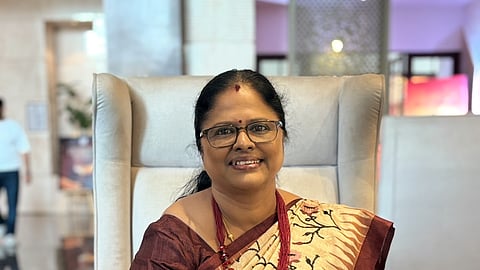

Before the first bite, there’s already a story on the table — the sharpness of pepper, the warmth of roasted spices, the quiet complexity of time-honoured techniques. Chef Athi Lakshmi’s An Ode to Kadaikudi at Feast, Sheraton Hyderabad Hotel is an invitation into that world, where Chettinad cuisine reveals itself in layers, each one more compelling than the last.
Drawn to cooking not just as a craft but as a cultural responsibility, Chef Athi Lakshmi begins, “I’m passionate about preserving our heritage. Chettinad cuisine is bold, aromatic, it carries our culture.” She speaks of spices not as ingredients, but as identity: black pepper, fennel, jeera, cardamom, cinnamon.

For her, this pop-up isn’t just about serving food, it’s about awareness. She lists them with ease: pirandai, mudakathan keerai, sundakkai, athalakkai — ingredients often overlooked in modern kitchens, yet deeply embedded in Tamil culinary wisdom.
What stands out is her commitment to authenticity. Every dish is prepared using homemade masalas — Chettinad garam masala, freshly ground chilli and coriander powders. When asked about balancing flavours for a diverse audience, she smiles, “We reduce the boldness slightly. It’s all about grounding the masalas — keeping them aromatic, not overpowering.”
The welcome drink, Panakaram, traditionally consumed during Ram Navami, it cools and hydrates the body. “We don’t always use edible camphor,” she clarifies, adding, “But it helps with body heat and dehydration. It improves immunity, reduces tiredness, and removes toxins. It’s natural medicine.” A delicate Mudavattukkal soup sets the tone — made using mudakathan keerai (balloon vine leaves), known for their medicinal properties, especially for joint health.
The appetisers arrive as a study in contrasts. The Kola Urundai, a Chettinad classic, features minced meat (usually mutton or chicken) blended with roasted spices, coconut, and herbs, then shaped into balls and deep-fried until crisp outside and juicy within. The Kozhi Sukka is a dry-style chicken preparation, slow-cooked with onions, curry leaves, black pepper, fennel, and a freshly ground masala, resulting in a dish that is intensely aromatic and packed with flavour.
For vegetarians, the Valakkai Kola offers a clever alternative — raw banana mashed with spices, lentils, and herbs, then shaped and fried to mimic the texture of traditional kola urundai. The Vegetable Fish Fry is a creative reinterpretation, typically using vegetables like banana blossom or yam, marinated in a tangy-spicy paste and shallow-fried to resemble the texture and flavour profile of fish.
The mains are where the cuisine truly asserts itself. The Murungakkai Kari Kulambu is a tamarind-based curry made with drumsticks (moringa pods) and meat, simmered in a rich gravy of roasted spices, coconut, and onions — earthy, tangy, and deeply comforting. The Nethili Meen Kolambu, made with anchovies, brings a sharper coastal profile, combining tamarind, garlic, and a robust spice blend that enhances the natural saltiness of the fish.
The Vathal Kulambu stands apart — made with sun-dried berries or vegetables (like sundakkai), simmered in a concentrated tamarind gravy with mustard seeds, curry leaves, and spices. Slightly bitter, tangy, and intensely flavourful, it reflects the bold complexity Chettinad cuisine is known for.
These are paired with nei soru, fragrant rice tossed in ghee, often lightly spiced with whole aromatics, offering a mellow counterpoint to the stronger gravies. The Mullu Murungai adai is a rustic, protein-rich lentil pancake made with drumstick leaves and a mix of dals, ground coarsely with spices — hearty, wholesome, and deeply satisfying.
The condiments — Pirandai Thuvaiyal and Sundakkai Thuvaiyal — are far from mere sides. Pirandai (Cissus quadrangularis) is ground into a chutney with tamarind, coconut, and spices, known for aiding digestion and bone health. Sundakkai (turkey berries), slightly bitter and medicinal, is roasted and ground into a bold chutney that adds depth and sharpness to the meal.
The experience ends as the dessert arrives in the form of Kavuni Arisi Payasam, made from black rice native to the Chettinad region. Slow-cooked with jaggery, coconut milk, and cardamom, it has a naturally nutty flavour and a dense, almost chewy texture — rich without being overwhelming, and deeply rooted in tradition.