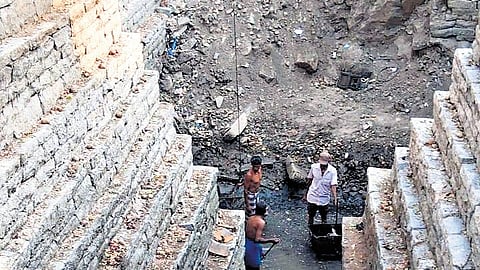

HYDERABAD: or decades, it lay buried under silt and neglect — a centuries-old stepwell forgotten by time, choked by debris, its water gone and its rituals silenced. Today, in the agrarian village of Peddadinne in Gadwal, the stepwell is slowly returning to life, bringing back not just water, but a shared cultural memory.
The restoration effort is led by Kalpana Ramesh, founder of the Rainwater Project, who has been working to revive traditional water systems across Telangana. The initiative began with an appeal from the priest of the nearby Venkateswara Swamy temple, where the annual Teppotsavam (float festival) had ceased due to the disappearance of the water body.
The stepwell, measuring about 12 by 15 metres and nearly 50 feet deep, was initially believed to be 200–300 years old and built for agricultural use. However, as work progressed, its history appeared deeper. Archaeologist E Sivanagi Reddy says the structure likely dates back to the late Kakatiya and Vijayanagara periods.
Fragments of stone carvings and temple iconography still remain, though many have been obscured by modern repainting. “Painting over heritage stone erases centuries of craftsmanship,” Kalpana tells TNIE.
Restoration has not been easy. One wall had collapsed, and the well was filled with 15 to 20 feet of silt. Due to its fragile condition, heavy machinery could not be used. Workers relied on manual labour and traditional pulley systems to remove debris, while carefully rebuilding the damaged wall alongside de-silting.
Funding posed another challenge, as projects linked to religious sites often fall outside CSR support. The work eventually received backing from private donors, including many from the US.

As the silt cleared, the stepwell began to hold water again. With an estimated capacity of over 1 lakh litres, it is expected to store rainwater and recharge groundwater in surrounding fields. For farmers, this could mean more reliable irrigation. For the village, it strengthens water security at a time of depleting borewells.
“These are climate-resilient systems,” Kalpana says. “Our ancestors built them to sustain agriculture and ecosystems.”
In villages like Peddadinne, water and culture are closely intertwined. The revival of the stepwell also opens the possibility of restoring the temple’s float festival and reconnecting the community with its traditions.
The project is part of a broader initiative, Baoli Art Sangam, which seeks to celebrate the intersection of history, culture and water through art across India.
A KAKATIYA PERIOD GIFT?
The stepwell, measuring about 12 by 15 metres and nearly 50 feet deep, was initially believed to be 200–300 years old and built for agricultural use. However, as work progressed, its history appeared deeper. Archaeologist E Sivanagi Reddy says the structure likely dates back to the late Kakatiya and Vijayanagara periods