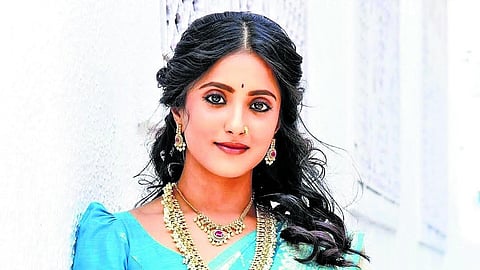

Acting wasn’t a choice Ulka Gupta arrived at, it was something she seemed to grow into. “I started when I was about six,” she says, recalling a childhood shaped by auditions and studio floors in Mumbai. “My mother and I were always going from one audition to another,” she adds. That persistence paid off early. A role in JD Majethia’s Resham Dankh, along with a handful of advertisements, marked the beginning of what would become a two-decade journey in front of the camera.
Television, at the time, was a powerful medium, and Ulka quickly found herself immersed in it. One show, however, left a lasting imprint. “Saat Phere really stayed with me. It spoke about skin colour and how a dark-skinned girl leads a different life. It moved me deeply,” she says. Being part of such storytelling helped her understand the weight of a lead role at a young age, an understanding that would shape her ambitions going forward.
Her breakthrough came with Jhansi Ki Rani, a role she fought hard for. “I must have given around 20 auditions and was shortlisted among thousands,” she recalls. Initially signed on for a short arc, Ulka ended up staying on the show for over a year and a half. “The love I received was overwhelming. I became a household name, and I’m still very grateful for that,” she shares.
Yet, the transition from television to films was anything but seamless. “I’ve always loved both mediums, but when it came to films, the opportunities were limited,” she admits. In Hindi cinema, she often found herself being offered peripheral roles. “I was usually cast as the sister or the youngest daughter. While I respect every role, I’ve always seen myself as a lead,” she notes.
Typecasting, combined with responsibility, meant she had to tread carefully. “I’m the breadwinner of my family, so I continued doing television. But I made sure the roles I chose were impactful,” expresses Ulka. It was a slow shift, one that demanded patience. She adds, “It took time, but I’m glad I broke through with Kerala Story 2.”
The film marked a turning point, not just professionally, but emotionally. “The subject was very serious, so the approach had to be different,” she says. Cast at the last minute, Ulka stepped into a process that required both sensitivity and restraint. “My research into the victims was disturbing. It affected me deeply but also helped me connect with the character,” she shares. What stood out for her was the trust she was given. “I value directors who allow you to explore. When they don’t show you how to act, that’s when your true self as an artist comes out,” she adds.
Parallel to her Hindi film journey has been her growing association with Telugu cinema, an industry she speaks of with genuine admiration. “There’s a sense of devotion on set. It feels like a place of worship,” she says. The language, initially a challenge, soon became part of her process. “Once I started understanding Telugu, I began enjoying it more,” says the actress. Ulka has three back to back Telugu movies lined up for release in 2026.
Her upcoming film, Rajni Ki Barat, brings her closer to home, both thematically and personally. “It’s a women’s empowerment story about a girl who takes her own baraat. It takes immense courage,” she says. But beyond the narrative, the film taps into Ulka’s own identity. “I’m a Maithili girl. I grew up in Mumbai, but I strongly identify with Bihar.” She pauses, then adds, “There are so many languages — Maithili, Bhojpuri, Angika, Magahi — and not enough awareness about them. That always stayed with me.” For her, the film becomes more than just a role. “It’s a tribute to my roots. A way of celebrating where I come from,” she shares.
As she looks ahead, Ulka is clear about the kind of cinema she wants to be part of. “I’d love to work with Mani Ratnam,” she says, naming filmmakers who have influenced her sensibilities. “In Hindi, I admire Anand L Rai and Imtiaz Ali — their storytelling stays with you.” There are also moments of reflection. “I regret not getting the chance to work with Irrfan Khan,” she adds, while fondly recalling her experience with Om Puri. Among actors, her inspirations are equally telling. “Konkona Sen Sharma, Tabu, Radhika Apte — they constantly choose path-breaking roles. I aspire to do the same,” she notes.
Off-screen, Ulka is still discovering her personal style. “Fashion, for me, is a work in progress. It should be comfortable and reflect your personality,” she admits. One constant, however, remains the saree. “I feel the most confident in it, it makes me feel elegant,” she says with a smile.
On days away from the camera, she gravitates towards simplicity. “Spending time with family and enjoying good food,” she says, before adding, “I also prioritise fitness — not for a body goal, but because it makes me happy.” Whether it’s badminton, swimming, or dance, movement is her reset. Ask her what cinema means, and the answer is immediate. “It’s my passion. My priority,” she concludes.
