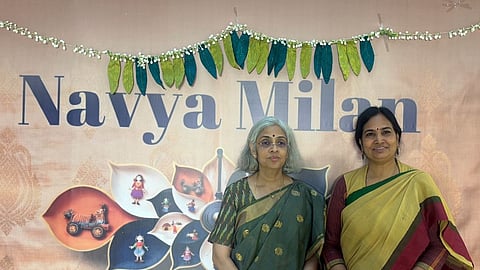

At a time when fast fashion continues to dominate wardrobes and conversations, Navya Milan brings the focus back to something slower, more thoughtful, and deeply rooted in culture and heritage. Hosted at the Craft Council of Telangana in Banjara Hills, the showcase brings together silk and cotton creations from the Krishna–Godavari belt, offering not just textiles, but stories woven over generations.

What really draws you in are the textures and the stories behind them. The sarees, especially from Gadwal and Venkatagiri, use a delicate blend of cotton and silk, woven together with incredible precision, sometimes taking days to complete. Then there are the Kondapalli toys, carved from softwood and finished with natural dyes, giving them their earthy charm. Nothing feels rushed or artificial; each piece carries the warmth of the hands that made it. The idea, as the organisers explain, is not just to display craft, but to bring it back into everyday life.
For Chitra Sood, co-founder of the Institute for Advanced Studies in Complex Choices, one of the driving forces behind the initiative, the journey began as something deeply personal. “It started from a very philanthropic kind of thing,” she says, recalling how her upbringing shaped her thinking about giving back. “After having worked for a reasonable amount of time, I thought it was very important that we really think about what we can do and give back to society,” Chitra added.
That commitment took on sharper meaning during the pandemic, when artisans struggled to find markets. “During the COVID phase, a lot of the artisans were really struggling to make both ends meet, and the markets had dried up. Then we embarked on this process, where we started training people. So that the craft remains alive,” she shares.
Meanwhile, for Sudha Rani Mullapudi, CEO and founder of Abhihaara Social Enterprise, who has worked closely with artisan communities for decades, the showcase feels like a culmination of years of groundwork. “It’s a dream come true because to have it in Crafts Council of Telangana is the most important and beautiful part of Navya Milan. The ambience and the kind of people who come here, along with its members who are huge patrons of the crafts, gave our artisans a lot of exposure, which is the best part of today,” she expresses.
Talking about the challenges, Sudha shares, “It is a challenging environment, because on one side we are talking about mass production, where many studios and websites mass produce products that are affordable but very costly for the environment and health. At the same time, one of the biggest challenges is that people are migrating to different jobs and are not interested in making the craft anymore. Therefore, it is now on women, to sustain the craft, as they lack employment opportunities in rural areas and are not used to physical labour. We saw this as an opportunity to invest in young women and build higher-order skills, since they were denied these opportunities for decades.”
What Navya Milan ultimately offers is more than a marketplace. It is an attempt to bridge the gap between the artisans and the urban consumers, between heritage and modern living. In doing so, it gently reminds us that sustainability is not just a trend, but a return to something we once knew well.