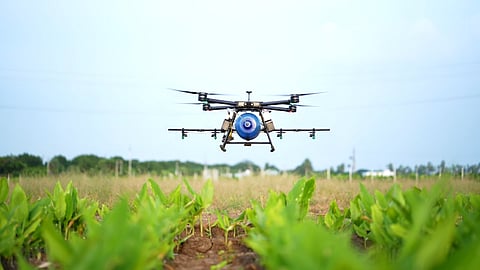

Hyderabad has long been an important name in India’s aerospace and defence landscape, and its growing startup ecosystem is adding another dimension to this reputation. As drones become increasingly important across defence, agriculture, logistics and industrial applications, the need for indigenous manufacturing and the technologies powering them is gaining momentum. From autonomous navigation and flight controllers to advanced batteries, composites and propulsion systems, homegrown capabilities will play a defining role in India’s aerospace journey. Hyderabad-based AKSI Aerospace Group is working across these critical areas, with an integrated approach to drone and aircraft manufacturing. In an exclusive chat with CE, AKSI Aerospace Group MD Pankaj Akula speaks about Hyderabad’s potential as an aerospace hub, Telangana’s proposed Aerospace and Defence Policy 2.0, India’s push for technological self-reliance, the evolving drone manufacturing landscape and his vision for the company’s future.
Excerpts
Telangana is preparing to introduce its Aerospace and Defence Policy 2.0, with an ambition to become India’s leading defence manufacturing hub. What opportunities could this create for companies in this sector?
Telangana has a strong aerospace and defence ecosystem, supported by defence PSUs, research institutions, precision engineering industries and skilled talent. The proposed policy offers an opportunity to move beyond traditional manufacturing towards indigenous ownership of critical technologies, intellectual property and complete aerospace systems.
For AKSI Aerospace Group, which is developing capabilities in drones, flight controllers, autopilots, advanced composites, batteries, propulsion and aircraft manufacturing, policy support can accelerate the transition from technology development to large-scale production.
The state has the potential to become a global centre for autonomous aviation technologies. Dedicated drone manufacturing clusters, common testing infrastructure, long-term industrial incentives and export-oriented manufacturing could help create an integrated ecosystem where aircraft and their critical components are designed, manufactured, tested and certified within Telangana.
What support do drone manufacturers need from the Telangana government in terms of infrastructure, incentives, testing facilities and research?
The biggest requirement is a complete industrial ecosystem that enables manufacturers to move from research and prototyping to testing, certification and mass production.
Telangana needs dedicated UAV flight-testing corridors for long-endurance aircraft, autonomous systems, beyond-visual-line-of-sight operations and high-altitude testing, subject to regulatory approvals. Specialised infrastructure for composite airframes, precision machining, batteries, electric propulsion, micro gas turbines and aerospace electronics is equally important.
The government should incentivise indigenous technology development and intellectual property rather than merely assembling imported components. Common facilities for environmental, vibration, electromagnetic compatibility and reliability testing would also benefit manufacturers.
Finally, industry-academia collaboration must focus on real engineering challenges, technology transfer and commercialisation. At AKSI, we are keen to work with the government on shared research, manufacturing and testing infrastructure.
How can Hyderabad’s growing aerospace and defence ecosystem encourage collaboration between established manufacturers, startups and MSMEs?
Hyderabad brings together established institutions such as HAL, DRDO laboratories, Bharat Dynamics, multinational aerospace manufacturers, startups and MSMEs. Large manufacturers contribute production expertise and market access, startups bring innovation, while MSMEs offer specialised manufacturing capabilities.
The next step is stronger integration to develop commercially viable aerospace products.
AKSI sees itself as a bridge between technology innovation and industrial-scale manufacturing. Through our specialised verticals, we are building capabilities across electronics, propulsion, aerostructures, energy storage, flight control and system integration.
We are also keen to develop supplier relationships with Telangana-based MSMEs for precision components, composite fabrication and electronics assembly. The objective is to create an ecosystem where technologies developed in Hyderabad laboratories become globally competitive aerospace products manufactured in Telangana.
What inspired you to establish AKSI Aerospace?
My inspiration came from a fundamental question: Why should a country with India’s engineering talent and scientific capabilities depend on imported technologies for critical aerospace systems?
Although India has made progress in aerospace research and engineering, several critical drone components, including flight controllers, propulsion systems, batteries and sensors, have historically depended on imports.
AKSI Aerospace was established with the conviction that India must move from being a consumer and integrator of foreign technologies to becoming a developer, manufacturer and exporter of indigenous aerospace systems.
Rather than concentrating on individual drone platforms, we invested in the underlying technologies, including composites, autopilots, batteries, propulsion, precision
engineering and aircraft manufacturing.
For me, AKSI represents more than a commercial enterprise. True Atmanirbharta means owning the knowledge, intellectual property and manufacturing capabilities to build and continuously improve our technologies.
Your drones cater to sectors ranging from defence and agriculture to logistics and industrial applications. Which segments are currently driving demand?
Defence and national security are important growth drivers, with increasing requirements for surveillance, reconnaissance, logistics, training and autonomous platforms.
Agriculture presents a significant long-term opportunity through precision spraying, seeding, crop monitoring and data-driven farm management. Through Khetpilot, we aim to make agricultural drone technology more affordable and accessible.
Industrial applications such as infrastructure inspection, mapping, surveying, environmental monitoring and security are also developing steadily. Cargo drones offer opportunities in defence logistics, emergency medical transportation and disaster response.
Our diversified portfolio allows technologies such as autopilots, batteries, composite structures and propulsion systems to be adapted across applications. We expect defence and industrial segments to generate higher-value opportunities, while agriculture and logistics could drive volume demand.
General Manoj Mukund Naravane’s recent remarks about India needing to scale up drone production to nearly 40,000 units a month have sparked discussion. How prepared is India’s manufacturing ecosystem to meet this demand?
The requirement of nearly 40,000 drones monthly highlights how unmanned systems are becoming high-volume industrial products rather than exclusively specialised aerospace platforms.
However, assembling thousands of drones is different from manufacturing them sustainably through secure domestic supply chains. Achieving this scale would require investments in motors, electronic speed controllers, flight controllers, batteries, sensors, composite structures, communications and automated manufacturing.
At 40,000 drones a month, annual production would reach approximately 4.8 lakh units.
Such volumes require an automotive-style manufacturing model with standardised components, modular designs, automated assembly, distributed suppliers and stringent quality control.
AKSI’s vertically integrated structure is designed to address this challenge by developing capabilities across airframes, autopilots, batteries, propulsion and system integration. India has the engineering capability to scale production, but sustained demand visibility, localisation and coordinated industrial policy will be essential.
With drones playing an increasingly important role in modern warfare, what technological capabilities should India prioritise to strengthen its defence preparedness?
India must prioritise technological sovereignty across the unmanned systems ecosystem.
Key areas include indigenous flight controllers and autonomous navigation, secure and resilient communication systems, advanced propulsion, high-performance batteries, composite structures and precision manufacturing.
Artificial intelligence will also play an increasingly important role in navigation, mission planning, situational awareness and coordinated unmanned operations, with appropriate human oversight and safeguards.
Additionally, India must strengthen domestic capabilities in electronic components, sensors, cybersecurity, testing and verification, alongside scalable manufacturing systems for both sophisticated and affordable unmanned platforms.
Defence preparedness cannot depend on individual drone platforms alone. It requires the ability to design, manufacture, maintain, upgrade and continuously improve underlying technologies, even during international supply-chain disruptions.
What’s the roadmap ahead?
Our roadmap is centred on transforming AKSI Aerospace Group into a globally competitive, vertically integrated aerospace and defence technology enterprise.
Over the next four to five years, we aim to expand indigenous subsystem manufacturing, particularly flight controllers, autopilots, smart batteries, composites, propulsion and precision engineering. We also plan to scale our unmanned aircraft portfolio across defence, agriculture, industrial and logistics applications.
Another priority is advancing aircraft development programmes, including two-seat aircraft, gyrocopters and personal aviation technologies, while pursuing the necessary certification and regulatory pathways.
We intend to strengthen international partnerships and exports, deepen collaborations with research institutions and government agencies, and develop a wider network of Indian MSME suppliers. We are also evaluating opportunities to expand our manufacturing footprint beyond Telangana while leveraging Hyderabad’s aerospace ecosystem.
By 2030, our ambition is to position AKSI among India’s recognised aerospace technology groups, supplying complete unmanned platforms, critical subsystems and selected manned aviation products to domestic and international markets.
Beyond manufacturing scale and revenue, our larger ambition is to demonstrate that Indian companies can develop globally competitive aerospace technologies, own their intellectual property and manufacture at industrial scale. India should not remain dependent on the world for critical aerospace technologies; it should become a country the world depends upon for aerospace innovation and engineering excellence.
