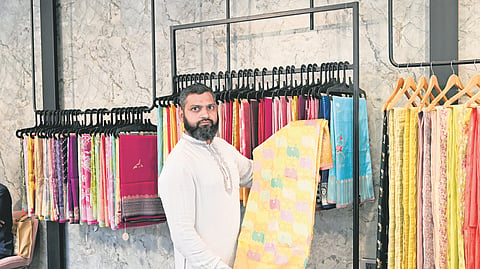

The beauty of a Banarasi saree is not always in what meets the eye. Sometimes, it lies in the little details that reveal the effort behind its making. Weeks of weaving, countless interlocked threads and motifs crafted one at a time — the kadwa technique is a process that allows no shortcuts. At The Banarasi Edit, a pop-up in Hyderabad, Sajid Mumtaz, founder of Meera’s Handlooms, showcased this age-old weaving tradition, where every motif is painstakingly created by hand. Taking weeks or even months to complete, each saree reflects the extraordinary patience, precision and skill of Banaras’ karigars.
“Kadwa weaving is done only by hand. Other weaving techniques can also be done using machines, but this particular technique does not use machines even today. That is what makes it so premium,” explains Sajid as he takes CE through the process of the technique.
Every design, be it small butis, floral patterns and intricate designs, in the kadwa technique is individually made. “The weft yarns are intricately interwoven in a secure manner. As a result, there is no loose thread on the back surface of the saree as in other methods. This gives a very clean look on both sides of the saree, and makes the motifs quite prominent on the fabric. The fabric does not require an extra trimming process at the end. In this manner, this technique is highly detailed and unique,” he explains.
And time is precisely what kadwa demands. Depending on the intricacy of the design, a single saree can take weeks or even several months to complete. Every motif requires the weaver’s individual attention, making the process as much about precision as it is about artistic expression.
“In Banaras, this technique has been practised from the beginning. Later, to reduce the cost and make the sarees more affordable, other techniques started being used. But we wanted to focus on kadwa because of the craftsmanship involved and the kind of quality it offers,” Sajid says.

For him, the commitment to this particular technique is also personal. “We are a group of genuine karigars who make these sarees with their own hands. My father formed this group of weavers, and everyone worked together irrespective of their religion or caste. We wanted a name that would be meaningful and pleasant to hear. Since Meera Bai is so well known in Banaras, that is how the name Meera’s came about,” he shares.
Although his parents encouraged him to pursue higher education, Sajid eventually found himself returning to the family’s weaving roots. Having completed his doctorate in Hyderabad and received multiple job offers, he chose to take the legacy forward instead.
“My father had started this work, and I thought, why not continue what he had built? I was getting job offers, but I wanted to do this and take Banaras’ legacy forward. That is how the group kept growing, and we started travelling across different states,” he says.
Their journey to Hyderabad was a conscious choice. Sajid believes the South has a deep appreciation for India’s cultural traditions and textile heritage, making it an ideal place to introduce the intricacies of Banarasi weaving. The group subsequently travelled to Vijayawada and other parts of the South, taking the craft beyond its traditional production centres in the North.