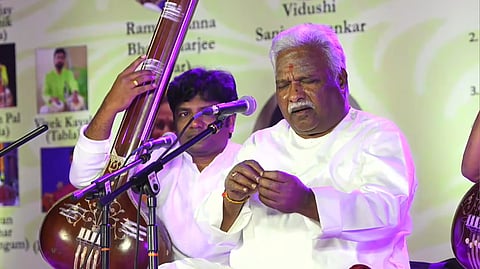

Bringing together the traditions of Kathak, Hindustani instrumental and vocal music, the National Festival of Music and Dance celebrated India’s classical heritage at Ravindra Bharathi. Organised by the Sangitanjaly Foundation, the two-day festival also honoured the legacy of Ustad Bade Ghulam Ali Khan while exploring ways to introduce classical music to younger audiences.
Opening the festival was Kathak exponent Dr Khushboo Panchal, who has 31 years of practise and a doctorate in the dance form. Hailing from Ujjain, Madhya Pradesh, where she also runs a Kathak academy, she began with a shiva stuti, drawing upon the city’s spiritual association with Mahakaleshwar. She then moved from devotional expression to pure Kathak before concluding with makhan chori, depicting young Krishna stealing butter. Trained in the Banaras and Kudau Singh gharana traditions, she combined expressive storytelling with intricate footwork. “Kathak is the one style where the story reaches the public easily. People understand what is being told,” she said.
The evening then moved from the rhythm of ghungroos to the melodies of the violin, with Ustad Johar Ali Khan presenting a recital accompanied by his brother, Ustad Asif Ali, on tabla. His rendition of Raag Jog highlighted the instrument’s expressive depth. Emphasising the need to take Indian classical music to wider audiences, he said, “Indian art must be taken to the world platform,” adding that the younger generation must carry the tradition forward.
Pt Venkatesh Kumar brought another dimension to the programme with a vocal recital of Raag Durga in Vilambit Teentaal. The Karnataka-born vocalist spoke about his fondness for Hyderabad and its audiences. “I love coming to Hyderabad because people here appreciate both Carnatic music and Hindustani classical music. I find great pleasure in performing for such an audience,” he said. Rooted in the Kirana tradition, he also expressed his admiration for Ustad Bade Ghulam Ali Khan’s distinctive gayaki. “I try to sing as he sang, but I can only ever try. There was no one like him,” he said.
Born in 1902 in Kasur, in undivided Punjab, Ustad Bade Ghulam Ali Khan belonged to the Patiala gharana and became one of the most celebrated vocalists of the 20th century. Known for his expansive khayal renditions and vocal agility, he eventually settled in Hyderabad after Partition and passed away here in 1968. The city, which became his final home and resting place, lends the festival a significance beyond its musical programme.
For Abhijeeth Bhattacharjee, author, social entrepreneur and chairman of the Sangitanjaly Foundation, the festival is both a tribute and an effort to keep classical music alive. A trained tabla player, he curates it alongside Prodyut Mukherjee, a Grammy jury member and GIMA award winner.
Sponsorships and artiste travel costs continue to pose challenges, though every performer is paid. Chandon Kumar Choudhary, a Kolkata native who has lived in Hyderabad for three decades, recalled a time when listeners would stand for hours to experience Hindustani classical music. “There are always pockets of people who care deeply about this. As long as they are there, the art will never fade away,” he said.
As the evening drew to a close, the legacy of Ustad Bade Ghulam Ali Khan felt less like history and more like a living presence, with the strains of his celebrated thumri, Yaad piya ki aaye, more naina bhar aaye, echoing through generations.
