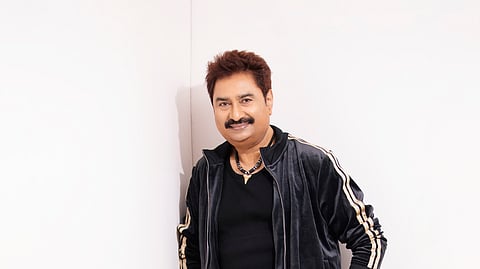

Some voices don’t just sing songs, rather become the voice of an era. Kumar Sanu is exactly that. From the heartbreak of Aankhon Se Tune Yeh Kya Keh Diya to the pure romance of Jab Koi Baat Bigad Jaye, and from the chartbusting soul of Aashiqui to the magic of Dil Hai Ke Manta Nahin, his voice defined Bollywood’s golden age of melody. Yet his musical journey stretches far beyond Hindi cinema — with a rich body of work in Telugu films like Ela Brathakanu, Vandanam Vandanam, and Oh O Cheliya, as well as songs across Tamil, Kannada, and Malayalam cinema, showcasing his versatility across languages and cultures. His blockbuster Aankhon Se Tune Yeh Kya Keh Diya, originally picturised on Aamir Khan and Rani Mukerji in Ghulam, recently found a whole new life when it was recreated for Raghav Juyal’s Bhai Tera Star Hai — with the makers choosing to retain Kumar Sanu’s original voice in the new version. Decades on, as a new generation discovers him through reels and recreated tracks, the ever popular singer opens up in an exclusive chat with CE about his legacy, reinvention, and what keeps good music timeless.
Excerpts
When you first recorded Aankhon Se Tune Yeh Kya Keh Diya for Ghulam, did you ever imagine it would still be finding new audiences 26 years later?
Nobody really thinks about these things that will be finding new audiences 26 years later, but it was so loved by audiences when it came out that it’s not surprising that people still like it.
Why do you think filmmakers keep returning to songs from the 90s?
Old music set the foundation for all evolving music. Calling the appreciation of the song nostalgia is undermining the power of that foundation. No matter how far into the future we go, we will always have to come back to the foundation.
How do you feel about becoming relevant to a new generation in this way?
Today’s generation is very much interested in old music, especially 90s music. You can look at so many reels and YouTube shorts with my songs, and also videos on social media of clubs and discos where as soon as a 90s song comes on, the youth enjoys it very much. Not just me, they listen to all 90s singers and make reels on their songs too.
What according to you has made your songs deeply rooted in people’s memories and emotions, even three decades later?
Back then, people did not have means to express themselves as much as they do today. They often used music to convey emotions and the same can be said for sad songs. People were more closed off from the world and did not have social media to share their feelings to a large number of people. Songs that were written in such a relatable way that it almost acted as a friend for them.
Did you feel the pressure of carrying the image of being a synonymous with romance?
I was really blessed to have worked with such great composers and lyricists who created those songs. It’s all a teamwork so the burden was never only on me. It’s not an image. It’s a connection with the audience. Some songs like Jab Koi Baat Bigad Jaye are not just romantic but pure love songs that can be sung for anyone. So that purity in music of that time was a privilege not a pressure.
Has there ever been a phase in your career where you consciously had to reinvent yourself?
My audience is very loyal. Actually most people from that time who love good music have remained loyal to that style and genre of music so I never had to reinvent myself because my audience connected with my authentic self and I am thankful for that.
A memorable experience or collaboration from the South?
I’ve sung many South Indian songs in Telugu, Malayalam, Kannada, Tamil, etc, and there’s a speciality that no matter how modern they make the music, the melody is intact. I’ve worked with fantastic composers like MM Keeravani, who is a musical genius who made songs with so much depth and so much sweetness. And see, now he has won an Oscar, but for an Indian song. There must be a special element — that’s why he won. You can see South Indian movies as well; they always show family, tradition, and culture.
What’s more on the plate?
I keep singing whenever I get the opportunity, and when those songs are released, you will get to hear them. I also release music on my YouTube channel. Recently, I collaborated with singer-songwriter and rapper King on a song after he approached me. I was initially a little unsure, but when he played the track for me and I realised it had a distinct 90s sound and sensibility, I was very happy to be a part of it. King is incredibly talented and, more importantly, a wonderful person to work with. The song did really well, and I think it also proves how timeless 90s music is. King belongs to the younger generation himself, and his love for 90s music beautifully reflects how that sound continues to resonate even today.

