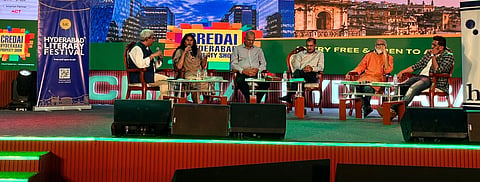

What makes a city feel like home? Is it the house we return to, the neighbourhood that knows our footsteps, or the memories we leave behind? On the sidelines of the CREDAI Hyderabad Property Show at Hitex in Hitec City, the Hyderabad Literary Festival and CREDAI Hyderabad turned that simple question into three days of conversations, readings and games.
“CREDAI has been a patron of the Hyderabad Lit Fest. Festivals like this exist to be the cue of a fast-changing city quietly needs, not to answer what Hyderabad is, but to keep giving people reasons to ask,” shares Kinnera Moorthy, one of the founding directors of HLF, and you could feel it in the shape of the weekend itself.
It opened, fittingly, with a panel — Finding Home, Making of a City, which was moderated by architect G Srinivas Murthy- principal architect- SMG Design Inc, and chairman- Indian Green Building Council- Hyderabad Chapter and known for documenting the city’s Art Deco heritage. The panelists — T Vijay Kumar, director- Hyderabad Literary Festival; Sajjad Shahid – convenor- INTACH Telangana State Chapter; Ayesha Rubina, educationist, social entrepreneur, social worker and former co-opted member of GHMC; and developer P Ramakrishna Rao, founder, managing director, Manbhum Construction company and a past CREDAI president.
The question underneath the panel was almost simple: whose city is this? Once, everyone agreed, Hyderabad meant something specific — a tehzeeb, a rhythm, a shared old-city grammar everybody understood without being taught it. Then Cyberabad happened. The Financial District pulled the map westward, mohallas gave way to gated communities with their own gyms and gardens and gates, and somewhere in that shift, a newer Hyderabad grew up that may never have met the older one at all. Even HLF’s own address has tracked this drift; from Taramati Baradari and Banjara Hills, to Knowledge City, almost on purpose.
Asked pointedly what developers can do about the insularity of gated communities, Ramakrishna didn’t deflect entirely — but argued how public life has to be built by the public and not developers alone. The discussion stayed somewhat unresolved, but one truth kept surfacing: a city becomes home only when people share something in common and that has to be deliberately made.
By the second day, the mood had softened into something closer to affection. The Little Theatre Hyderabad read from writings about the city’s people — English sliding into Telugu, then into Urdu, and back — including pieces from Untold Charminar and Sarojini Naidu’s poems that landed the way old poems do, quietly. A reading on Hyderabad’s ghost stories drew laughter and recognition in equal measure, the sound of a room realising it already knew this place, even the parts of it that don’t officially exist.
Finally, the third day closed the way good weekends often do — with trivia nobody saw coming. A quiz stitched entirely from Hyderabad-shaped questions produced its best surprise near the end: a photograph of a young man who turned out to be Winston Churchill, who apparently met his future wife at the British Residency, right here, long before the rest of history caught up with him.
By the time it was over, nothing had really been settled, but something did shift anyway. Perhaps that is what a literary festival does best: it doesn’t necessarily offer answers, but creates a space for a city to pause, listen and recognise itself in the stories of others.
