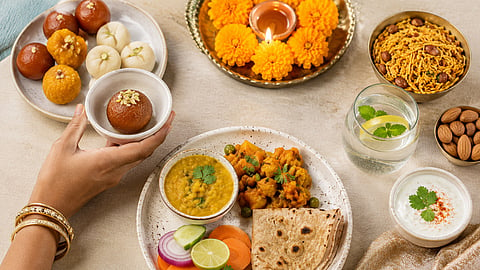

Festivals are often as much about food as they are about traditions, with mithai, fried snacks and elaborate meals becoming part of every gathering. Yet, enjoying these foods does not have to mean abandoning healthy habits. As National Nutrition Week, observed from September 1-7, puts the focus on balanced nutrition, people are increasingly choosing moderation, portion control and mindful eating instead of completely avoiding their favourite festive foods.
With food being at the centre of most celebrations, maintaining regular eating habits can often become challenging. Swetha A, deputy chief dietitian at Yashoda Hospitals, Secunderabad, points out that festive eating can become difficult when food is available at every gathering and meal timings become irregular. “It can be difficult to maintain a balanced diet during the holiday season due to the abundance of high-calorie sweets, fried snacks, as well as social pressure to indulge and irregular meal times,” she says.
Rather than following a one-size-fits-all approach, nutrition also depends on an individual’s needs and health status. Dr Latha Sashi, chief nutritionist and head of the department of nutrition and dietetics at Fernandez Hospital, explains that enjoying festive food comes down to understanding individual requirements rather than following a fixed rule. “Eating well actually means eating ‘correct portions’ as per your age, physiological status, clinical condition, and present BMI,” she says.
One practical way to manage indulgence is to build the meal around filling foods before reaching for sweets. Swetha suggests choosing healthier versions where possible and being mindful of how much is served. “Choose baked or air-fried versions of traditional snacks, eat smaller portions of sweets, and prioritise foods high in protein and fibre, such as salads, dal, and paneer, before indulging in treats, to enjoy festive foods guilt-free. This strategy helps control blood sugar levels and avoid overindulging,” she expresses.
Portion control, however, does not mean measuring every bite. Swetha recommends, “Use smaller plates and serve sweets in bite-sized pieces. Pay attention to your body’s signals of fullness; eat slowly, enjoy each bite, and stop when you feel satisfied rather than stuffed.”
Along with watching portions, there are also ways to improve the nutritional value of festive dishes while retaining their familiar flavours. Dr Latha narrates, “We can enhance the nutritional quality by the addition of fruits, dry fruits and use of whole grains like red rice, moong, quinoa, millets, etc., but the calories do not change, so portion control is the key.”
A simple plate method can further help people have a little of everything while keeping the meal balanced. Swetha explains, “A balanced festive plate should follow the ‘plate method’: fill half with vegetables or salad, one-quarter with protein (dal, curd, lean meat), and one-quarter with whole grains (brown rice, millet roti). This ensures you receive essential nutrients like fibre, protein, and vitamins while still enjoying festive flavours.”
With repeated offerings at family gatherings and office parties, however, the urge to try everything can make moderation harder. Swetha observes, “Emotional eating and the urge to ‘try everything’ frequently results in excessive calorie intake and the biggest obstacles during festive eating are repeated offerings from different parties, which make it difficult to resist overindulgence.”
When festive indulgence happens, the next step is just as important as what was eaten. The answer is not to compensate by skipping meals or exercising excessively the following day. Swetha advises, “Skipping meals, fasting, or over-exercising to compensate for indulgence are unhealthy strategies. Instead, return to your regular routine the next day with lighter, nutrient-dense meals, stay hydrated, and incorporate gentle physical activity like walking. Consistency matters more than extreme measures.”
Food is only one part of staying well during the festive season. Dr Latha stresses, “Hydration is very important during festivals as the high-fat, high-sugar, and high-salt preparations may lead to dehydration and may have an impact on digestion, leading to constipation in vulnerable groups. Similarly, optimal sleep is helpful.”
For those looking for a flexible approach, Swetha recommends the 80:20 principle. “The 80:20 approach — eating nutritiously 80 percent of the time while allowing 20 percent for festive treats — is a realistic and sustainable way to maintain a healthy relationship with food. Practical tips include planning indulgent meals in advance, choosing your favorite sweets mindfully, and avoiding restrictive dieting. This balance prevents guilt while supporting long-term wellness,” she notes.
Ultimately, festive eating need not be a choice between strict discipline and complete indulgence. A little planning, smaller portions, and room for favourite meals can make celebrations enjoyable while keeping nutrition in the picture.
