
Let’s picture Vrindavan not as a painting, but as a wardrobe. Yamuna blue flowing through silk, moss green settling into handloom, marigold yellow appearing as a border, terracotta finding its way into embroidery and old rose softening a festive drape. Beyond the familiar peacock feathers and flute motifs, the landscape of Krishna’s childhood offers a quieter, more nuanced vocabulary of colour, texture and craft. This Krishna Janmashtami, CE explores how designers are drawing from the sights, moods and symbolism of Vrindavan to create festive fashion that feels rooted yet contemporary.
Palette of Vrindavan
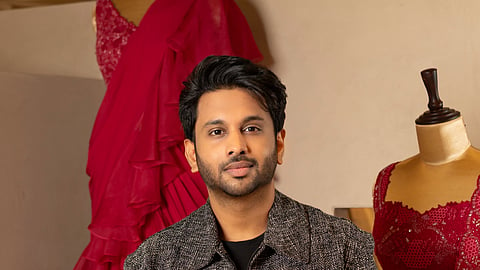
For celebrity fashion designer Varun Chakkilam, the starting point is colour — but not in its brightest, most obvious form. He shares, “For me, Vrindavan immediately evokes the deep, fluid blue of the Yamuna, monsoon greens, marigold yellow, muted terracotta and earthy browns. There is also a softness to the palette which has dusty pinks, off-whites and aged golds that reflect the timelessness of the city.”
The trick, he says, is not to put every shade into one outfit, but to let them speak to one another. “A deep Yamuna-blue sherwani with antique gold embroidery, a muted-green lehenga with tonal embellishment or ivory punctuated with marigold and antique gold can bring the landscape into festive wear without making it feel overly traditional. I would pair a saturated colour with a quieter neutral rather than putting several strong colours together,” he notes.

And then there are the details that usually escape the obvious Krishna moodboard. He finds inspiration in Vrindavan’s winding lanes, old painted walls, temple architecture, carved doorways, bells, kadamba trees, weathered sandstone, flower markets and even the everyday presence of marigold and jasmine.
He adds, “These elements can translate beautifully into embroidery through abstracted florals, architectural lines, geometric borders, textured surfaces and layered motifs. It gives the collection a sense of place without making it feel like a costume interpretation of Vrindavan. Instead of embroidering a Krishna figure, for example, you could interpret the movement of the Yamuna through fluid lines, or translate the serenity of the surroundings through softer silhouettes and tonal embroidery.”
Texture of tradition
Coming from a handloom family, Sridevi Kalimishetty’s connection with Krishna’s costume is equally hands-on: she worked on Mahabharat for Star Plus under designer Nidhi Yasha of The NY Studio, with the mentorship of Oscar-winning costume designer Bhanu Athaiya. As part of the costume and styling team, she worked on Lord Krishna’s character, creating and styling his looks.
That experience, she notes, made one thing clear: a costume can tell a story long before a motif appears on it. And textile, she says, can become a way of expressing the many Krishnas within the mythology.
Founder of The Art of Layers says, “For his playful side, I imagine lightweight cottons, playful prints, brighter colours and fluid silhouettes. For his romantic and youthful side, soft silks, Chanderi, delicate textures, floral details and softer colours work beautifully. For the royal Krishna, I would look toward rich silk, Banarasi textures, zari and deeper jewel tones. And for the warrior aspect, I would move towards stronger textures, structured drapes, darker earthy colours and more defined borders.”
Traditional techniques, she notes, can make the palette even richer. Natural dyeing, Bandhej, block printing, Kalamkari, tie-dye and resist dyeing can create multiple variations.
The styling, she says, is where modernity comes in. “The blouse could carry intricate details while the saree remains relatively understated, allowing the handloom fabric, colour, texture, and drape to become the hero. Structured sleeveless blouses, square and boat necks, elbow-length sleeves, contemporary backs, graduated pleats, layered construction, tucking, quilting and textural detailing can give the traditional textile a distinctly modern silhouette,” notes Sridevi.
The same approach works for dresses, too. Flowing maxi and midi dresses in Chanderi, Ikat, cotton-silk, handloom cotton or soft silk can bring movement to the palette, while dhoti-inspired silhouettes, layered constructions, colour blocking and tone-on-tone combinations add a contemporary edge.
For men, muted blue, ivory, mustard, earthy green and deep indigo can move into handloom cotton and silk kurta-pyjamas, textured stoles and woven jackets with self-textures or jacquards. For women, handloom kurtas can be paired with wide-leg palazzos, layered pants or straight trousers and finished with Ikat, Kalamkari or block-printed dupattas.
Sometimes the smallest element can change an entire look. And a dupatta, is certainly that. “A dupatta is almost like a moving canvas. It gives you an opportunity to introduce colour, print, texture, and craftsmanship without changing the entire outfit. A Paithani-inspired weave with a Bandhej dupatta, for instance — or a dupatta inspired by the landscape itself, using flowers, foliage, water patterns and earthy colours rather than literal Krishna imagery,” she notes.
Her minimal Janmashtami choice remains a textured handloom saree with a contemporary blouse, followed closely by a simple handloom kurta set with a statement dupatta.
Jewels with a hint
For Vipin Sharma, chief merchandising officer of BlueStone, Janmashtami occupies a sweet spot: celebratory, but intimate; festive, but not formal.
The colours of Krishna’s world translate almost naturally into gemstones.
“Peacock blue and monsoon green live in aquamarine, blue topaz, emerald and peridot. Marigold finds its way through citrine and yellow gold. marigold through citrine and yellow gold; pink through rose gold, tourmaline and morganite. This is a palette that already exists in gemstones,” he notes, pointing to the Neelja ring, where a carved stone moves from blue into green, capturing the transition from peacock to monsoon in one piece.
But the most interesting Krishna references, he says, are the ones that do not immediately announce themselves.
“The feather and flute are lovely, but they are literal — and the more interesting design work is usually one step removed from the obvious symbol. Water can become fluid forms. The lotus can become a modern silhouette. The jhula can become the movement of a drop earring or pendant. Even a feather can be reduced to a delicate gold detail. A deep blue-green in a piece evokes Krishna without depicting anything at all — which is often more elegant than a representational design,” he concludes.