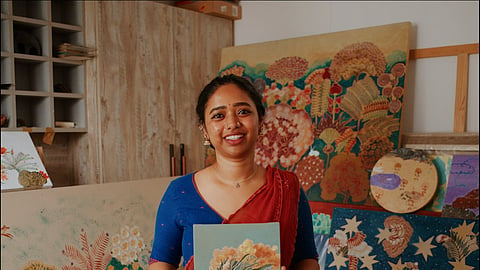

Stories have a way of refusing to stay still. Born in oral traditions and folk narratives, they travel across generations and forms, finding new lives in paintings, films and contemporary art. Each retelling carries a trace of what came before, while opening the door to a new interpretation. For artist Priyanka Aelay, this fluidity of storytelling which is rooted in nature, Indian heritage and folk traditions, has become an integral part of her artistic practice.

Her latest work, The Mystical Mirror, a documentary made in collaboration with Katha & Kin’, draws from a South Indian folk story and explores the way stories can be reimagined through an artist’s perspective.
At the heart of the documentary is an artwork that draws from a story Priyanka has explored through her research. She explains, “The Mystical Mirror talks about a folk story that I researched, called Balanagamma (Janapada Katha). It is a South Indian folk story, and this piece of art is from an episode of the story that I derived and interpreted in my own style.”
This interpretation also gave her an opportunity to look at the characters and their roles from a different perspective. She narrates, “The Mystical Mirror is more related to one of the episodes from the folk story where the villain looks in the mirror and asks for the most beautiful woman. The mirror then shows the most beautiful woman, who is the heroine of the story. Similarly, I was trying to represent how the male and female gaze works throughout the story.”
The journey of bringing this artwork and her larger practice to the screen began with an unexpected interaction online. Speaking about how the association with Katha & Kin’ began, she says, “I just reshared one of their videos on my social media, and they got in touch. They were really interested in capturing my artistic journey through their documentary. I think both of our ideas met at some point.”
That shared interest in preserving stories also shaped what the documentary set out to capture beyond the artwork itself. She says, “The documentary looks at not just the artistic journey but also my research. My artistic interpretation is something the documentary has been looking at from the beginning till the end, and it also shows my own practice in my studio space.”
For Priyanka, this connection to traditional narratives did not begin with her artistic career, but much earlier in life. Recalling those early influences, the artist shares, “I was exposed to subjects related to Indian mythology, history and folk narratives from a very young age through my father.”
As these influences continue to evolve, Priyanka sees new ways of keeping the stories behind them alive for future generations.
“As long as we maintain and try to preserve these art forms in newer ways, we will always be able to preserve them in the future because generations and times have been changing. Therefore, it is the need of the hour that we try to tell these stories through different forms, such as videos, storytelling, art, music, or dance, that can connect to the younger generation. That is when the art will survive for a long time,” she concludes.