
KOCHI: Radhika and Mani have a sixteen- year-old daughter, Shalini.
Till Class 10 Shalini was a good student. In Class 11, she suddenly refused to go to school for a fortnight.
She did not want to continue her studies, she said. She lay on her bed for hours together and neither ate nor watched television.
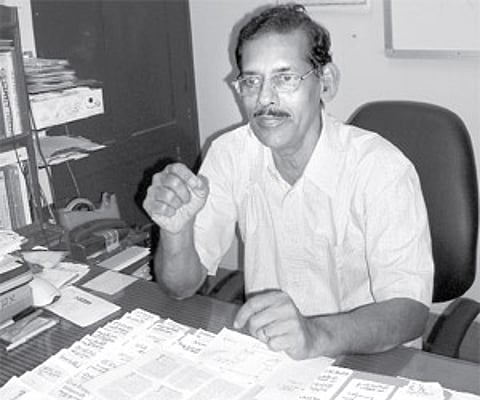
Worried, Radhika, a bank officer, took her to V J Antony, a counsellor with 28 years’ experience.
Antony asked her point-blank: “Do you love your daughter?” Tears welled up in Radhika’s eyes.
“Can I bring up my daughter without loving her?” she asks. Antony spoke to Shalini in private. This was her story: Her father worked in a ship and was away for months together. Her mother would go to work at 8.30 am and come back at 6.30 pm. “When my mother returns home, she does not even look at me but goes straight to the kitchen,” she said.
Sometimes Shalini would follow her mother to the kitchen. But Radhika would get angry and shout, “Go and study. Why are you bothering me like this?” After a while, Shalini stopped going to the kitchen. “She is not a mother to me,” she says. “She is just a lady who provides food and sends me to school. That is all.” As for Shalini’s father, when he returns after eight months at sea, the first thing he does before he greets the family is check the bank passbook. If the cash balance is not to his liking he shouts at Radhika for over spending.
Throughout the two months he is at home, Mani quarrels with Radhika. “My father never speaks to me,” says Shalini. “My parents don’t love me at all.” At this point of the story, Shalini raised her left arm to show Antony a thin red line across her wrist. “I tried to kill myself with a blade, but lacked the courage to cut deeper,” she said. “But I am sure there will come a time when I will be able to do it.” When Antony tells Radhika about the suicide attempt she breaks down. “I get up at 5 am and work non-stop till 11 pm, 365 days a year,” she said. “After all this, if Shalini says I don’t love her, please tell me what love is?” What Shalini yearns for, says Antony, is physical affection. Parents have the mistaken notion that if they worry about their children or plan for their future, that is love. “That is ‘like’ and it remains only in the parent’s mind,” he says. “Children must receive physical affection to know they are loved.” Otherwise, no matter how many gifts parents buy their children there will be no emotional connection.
When there is no emotional connection, by the time they are in class eight the children go astray. “Either they do poorly in school or fall into bad company and indulge in drugs, drinks, and criminal activities,” says Antony.
The girls have love affairs with men of dubious character.
He cites the case of a family which received a Rs 15,000 telephone bill one month. Investigation revealed that their 15-year-old daughter had been making hundreds of calls to one particular number. It turned out that she was having an affair with a hoodlum.
What has exacerbated the problem is the impact of the mass media.
“Youngsters who see love stories on TV don’t realise it does not work in real life,” he says. “In the films, the hero is abusive and violent. Drinking is shown as a fun thing.” And of course, there is the Internet and the powerful impact of pornography. “The boys erroneously assume that all girls are crazy for sex,” says Antony. It is no surprise that most youngsters are confused these days and are unable to distinguish between right and wrong.
In this troubled state, for most children, it is friends, and not parents, who are the centre of their lives. “Parents don’t realise this until their child falls into trouble,” says Antony. “By then it is too late.” 70 percent of children are emotionally troubled these days, says Antony. The solution, Antony suggests, is to maintain open communication links between parents and children all the time. “Children should feel that the home is a happy place,” he says. “They won’t mind if they are scolded once in a while, provided there are positive vibrations the rest of the time.”
(Some names have been changed)
Childhood abuse leads to violent behaviour in adulthood
Traumatise d or unhappy childhoods have been the root cause of anti-social behaviour of many criminals and dictators. Retired electrician Josef Fritzl was found guilty of incest and murder in Austria recently. He had a 24-year long incestuous relationship with his imprisoned daughter, Elisabeth, in a cellar at his home in Austria.
Fritzl says he was a victim of neglect as a child. “My mother did not want me,” he said to the judge during the trial. “She was 42 when I was born.” Fritzl’s father, according to him, was a scoundrel whom his mother threw out of the house when he was five.
Joseph Stalin was born to a cobbler, Vissarion Jughashvili, and Ekaterina Geladze. Stalin’s father, who was often drunk, beat him and his mother regularly. One of Stalin’s friends said, “Those fearful beatings made the boy as heartless as his father.” Adolf Hitler’s father, Alois Schickelgruber, also beat his mother and him often. Hitler once told his secretary that during one of the beatings, he was able to stop crying, and count the thirtytwo blows he received.
Says psychologist Alice Miller: “Humiliation, spanking, beating, slaps on the face, betrayal and sexual exploitation injure the integrity and dignity of a child. Even if their consequences are not visible right away, most abused children will make others suffer as adults.” Miller says Hitler was incapable of empathy for others.
Hitler and Stalin went on to reach positions of absolute power where they killed lakhs of people, either through war, or concentration camps. “These cases show that the mistreatment of children is an immeasurable danger to society,” says Miller.
shevlins@gmail.com