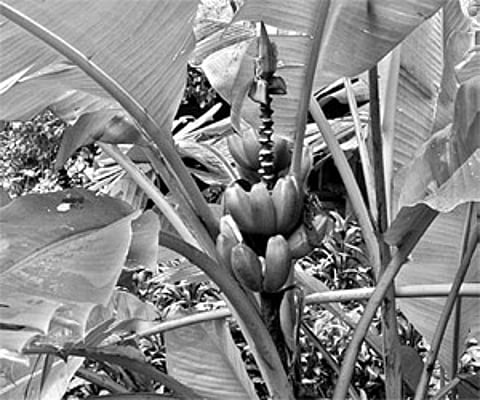

KOCHI: Musa or the banana plant is one of the most striking members of monocots. There are many types of musa largely cultivated for its fruits, but there are some not so common (found as part of elite landscaping) ornamental varieties which are significant in utility based landscaping. The inflorescence, especially the beautifully whorled bracts, has earned the plant an important place in floral arrangements.
The musa variety flourishes in loose wet organic soil and so thrives near waste water exits of your house. M paradisiaca is a commonly found variety in Kerala, grown for its nutrient rich fruits and the leaves that are widely used to serve food. As the leaves are easily shredded by harsh air movements it should be planted in areas with less air movement. The musa needs sunlight for its healthy growth and does well in courtyards and at pool sides. As a cluster of plants originate from the suckers they form good masks. The withered leaves must be removed from the plant on a regular basis, however the sheathing leaf base should not be disturbed as it protects the plant from drought.
Mornata, an ornament variety grows to a height of 10 feet with leaves almost 5 feet in length and produces pinkish bracts and yellow orange blooms. The bracts remain attached to the plant for several weeks adding to its beauty. However, when the bract size decreases and more fruits get exposed the plant becomes less attractive.
During this period the plant can be cut at the base so that more shoots appear from the nearby suckers.
M coccinea is another attractive variety popular for its cut flowers.
Its bracts are a deep red with a tinge of yellow and can be grown as a stand alone plant in prominent locations. M velutina is a dwarf variety of musa having upright pink bracts with orange flowers. Both the above varieties are grown for its ornamental value.
They can be grown in clusters so that the blooms provide a feast for your eyes.
All varieties of musas require regular manuring and ample water for healthy growth. If well watered they retain their leaves for long. If propagation from suckers is low you can resort to tissue cultured plants, especially in the case of ornamental varieties.
The best way to avoid plant diseases is by keeping insects away as most diseases are transferred through them. This can be done by applying neem based pest repellant on the leaves once a fortnight.
subramanianm@epmltd.com
M Subramaniam
(The author is a landscape artist)
